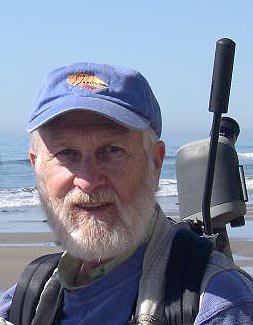
It was one of those calls that comes in the middle of the night, about 9:30 p.m. in my case. I had just finished a fairly descent glass of Riesling; it was perky without being pretentious. We were sitting on the deck enjoying the reluctant sun as it headed for California, when the phone rattled and danced on the patio table.
Caller ID said it was Tom, which meant it was probably fishing related and safe to answer. He had an emergency brewing. Dinner guests would be arriving at his place in less that 24 hours and he was under the gun to have some trout on the table. Could I make a supreme sacrifice, tomorrow morning, and go fishing.
Hmmm, this was a tough call. I made a mental rundown of the things on my to-do list and told him fishing might fit right in. I had planned to rearrange my sock drawer on Thursday, however, for him and the cause, I’d bite the bullet and pack up my rod, etc.,
After I committed to go he told me John would be going along, too, and, by the way, could I bring that bamboo rod I had restored this winter. They felt the rod needed some thorough testing on some real fish—trout in other words.
The rod is a real beauty. My guess is, it was built in the early 1900s and It is destined to go on the wall as an art object, like several other restored bamboo rods I have. I have a lot of mixed emotions about antique rod restoration: these things were made to catch fish, not hang on the wall. However, a lot of hours (pleasure-filled hours I should say) go into a project such as this and … What the heck. Better to burn out than rust out, I say.
There was a lot of the good-natured joking around as we lined up the rods in the parking lot at Rockwell Springs early Thursday morning. The bamboo rod (a gift from Susan) is a three-piece, 10-footer, not built in the usual hexagonal form, but in a round shape. Like a really long willow branch. Rods and lines of the past do not match up with current equipment. I was guessing at the proper line weight for this baby, but felt I was in the ballpark by choosing a line from the middle of my collection of reels and lines.
The best way to describe casting with this beauty is to imagine throwing a line with a 10-foot-log piece of spaghetti. And that noodle would weigh three or four pounds—or so it seemed. After three casts I knew why fly fishing was slow to catch on in the last century. It was proof that it’s not always about catching fish. Sometimes it’s about the beauty of the day and the tackle …
After managing two rainbow trouts, I deemed the rod well broken in and ready to take its place on the wall. Tom and John each took a turn and we all agreed, fishing with today’s stiffer, lighter rods made the sport more enjoyable. These fine old bamboo rods fit the era in which they were designed, when the pace of life and the pace of living were slower and more deliberate. As best we could tell, the fish didn’t seem to react any differently, no matter what we used. And our skills, as fishers, had to be the same as the person who lined up this old rod—when it was the new rod.
I thought about how the original owner, maybe 100 years ago, faced the same challenges we face today, which is another part of fly fishing’s appeal for me. Our tackle, today, is certainly technologically superior, however, the fish don’t know that.
Thursday, June 25, 2009


Wednesday, June 24, 2009
Deserved Recognition
Well, it’s been a long time coming, four billion years or so, however the stick has finally been recognized for what it is—and made it to the Hall of Fame. That’s the National Toy Hall of Fame in Rochester, New York.
Let me back up a bit. Sometimes news is slow getting out here to Ohio. Just today I learned that the stick was inducted into the Toy Hall of Fame last November.
Right, the stick, the play toy of millions and millions of generations of kids. Now it’s right up there with the heavy hitters like Mr. Potato Head and Barbie. The stick. Any stick. The toy that can be anything to any one.
I am a bit upset that the Toy Hall bestowed the honor before the American Museum of Fly Fishing had a chance to recognize the stick for virtually the same reasons. I’ve had many a day when I caught more sticks than fish—and was happy for the tug on the line.
It often works like this: You’re up or downstream from a fishing buddy. You hear his occasional whoop and holler and see his line dancing all over the stream. You’re doing nothing. Then you feel the big strike! Whoa there, this is serious stuff. The fish swims out into the stream and is headed downstream with huge effort. You fight as carefully as you can, hoping the tippet will hold because this lunker certainly surpasses whatever rating the manufacturer had written on the spool.
Even with your best efforts you can’t turn him. He keeps heading downstream. That should be your first clue. But you’re Fishing the Denial River and disregard the obvious. You're making progress. You have him on the reel and he’s moving closer. Out of the corner of your eye you’ve seen your buddy casting a glance in your direction, hoping to see the fish. You fumble around your back for the landing net as you control the line with one hand. Your first glimpse of this whopper makes your heart sink. It’s a stick. A stick. My dad used to tell us kids it was a grass pike he had on the line. We, of course believed him.
Your mind kicks in as you realize you have to save face with your buddy. The best strategy is to get your body twisted into a really awkward position, hopefully with your back to your friend. You lunge for the “fish” and break it loose with the top of the net. Sometimes this means sacrificing the fly, however, you also salvage your reputation. Cursing and swearing, even pounding the water with the net is required at this point.
You turn to your friend, who has been watching all of this, and shout, “Huge brownie! Broke him off with the damn net!” A bit more pounding the water to emphasize your frustration might be required.
Tie on a new fly and hope for a return of another big one.
So, while it’s great that someone has recognized the stick’s ability to fill the imagination of children around the world since forever, it’s equally important for the fly fishing community to rise to the occasion and give the stick it’s due for it’s ability to raise the expectations and fill the imaginations of fly fishers the world over.
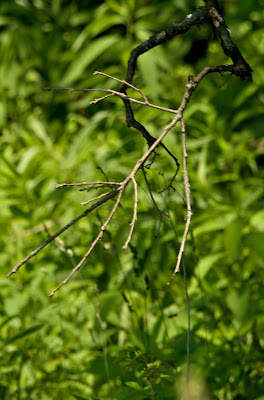
A Future Hall of Famer
Let me back up a bit. Sometimes news is slow getting out here to Ohio. Just today I learned that the stick was inducted into the Toy Hall of Fame last November.
Right, the stick, the play toy of millions and millions of generations of kids. Now it’s right up there with the heavy hitters like Mr. Potato Head and Barbie. The stick. Any stick. The toy that can be anything to any one.
I am a bit upset that the Toy Hall bestowed the honor before the American Museum of Fly Fishing had a chance to recognize the stick for virtually the same reasons. I’ve had many a day when I caught more sticks than fish—and was happy for the tug on the line.
It often works like this: You’re up or downstream from a fishing buddy. You hear his occasional whoop and holler and see his line dancing all over the stream. You’re doing nothing. Then you feel the big strike! Whoa there, this is serious stuff. The fish swims out into the stream and is headed downstream with huge effort. You fight as carefully as you can, hoping the tippet will hold because this lunker certainly surpasses whatever rating the manufacturer had written on the spool.
Even with your best efforts you can’t turn him. He keeps heading downstream. That should be your first clue. But you’re Fishing the Denial River and disregard the obvious. You're making progress. You have him on the reel and he’s moving closer. Out of the corner of your eye you’ve seen your buddy casting a glance in your direction, hoping to see the fish. You fumble around your back for the landing net as you control the line with one hand. Your first glimpse of this whopper makes your heart sink. It’s a stick. A stick. My dad used to tell us kids it was a grass pike he had on the line. We, of course believed him.
Your mind kicks in as you realize you have to save face with your buddy. The best strategy is to get your body twisted into a really awkward position, hopefully with your back to your friend. You lunge for the “fish” and break it loose with the top of the net. Sometimes this means sacrificing the fly, however, you also salvage your reputation. Cursing and swearing, even pounding the water with the net is required at this point.
You turn to your friend, who has been watching all of this, and shout, “Huge brownie! Broke him off with the damn net!” A bit more pounding the water to emphasize your frustration might be required.
Tie on a new fly and hope for a return of another big one.
So, while it’s great that someone has recognized the stick’s ability to fill the imagination of children around the world since forever, it’s equally important for the fly fishing community to rise to the occasion and give the stick it’s due for it’s ability to raise the expectations and fill the imaginations of fly fishers the world over.

A Future Hall of Famer
Monday, June 15, 2009
Just Another Day at the Office

The sun was lightening the sky as I backed out of the drive. The brightest object in the sky, however, was the last quarter moon about 30 degrees above the horizon in the southeast. It looked like a great day to be heading for the office.
I tuned in the local NPR station to catch up on the latest world trauma I can do nothing about. Sounded like the same news cast that’s been going on for 10,000 years. Will we ever get smart?
As I cruised down Oak Hill Road in the Cuyahoga Valley National Park I caught the local traffic report. Jams here, problems there. My traffic stopper was a Wild Turkey that dashed across the road. Then two white-tailed deer, a button-buck and a doe, politely waited for me to pass before they crossed. Did those deer look both ways before crossing? I think so.
I love traffic problems like this. As I unloaded (Or is that uploaded?) a backpack filled with camera gear in the parking area near Everett Road Bridge, a guy in a really cool Lexus convertible, red, slowed and looked (wistfully?) at me. His white shirt and tie told me he was not going to be heading for the back country this morning as I was about to do. The temperature had dropped to 48 degrees, great for hiking.
The first half mile is all uphill. I worked my way up and over to where Susan and I had spotted a family of Scarlet Tanagers yesterday. We had watched as the parents fed three youngsters—and me without a camera! We found the nest by accident. We had been led to the spot by a Veery, singing. The flute-like sounds of a Veery are not common around here. At Susan’s suggestion we sat on a log and waited as the Veery moved up the ravine and, eventually, to within 20 feet of our spot. I nearly ground my teeth down to the gums as the bird performed for us. It was activity almost above our heads, however, that distracted us from the Veery. We could hardly believe our eyes when we saw a pair of tanagers. We watched as they cautiously took food to their nestlings. After 15 or 20 minutes, one of the nestlings left the safety of its home and ventured out into the world. The parents were not happy about this, however, they continued to feed the brave one.
I feared that they might all be gone when I returned Monday morning. Grrrr, I hate it when I’m right sometimes. The nest was abandoned. The female and one of the youngsters were high in the canopy above me, too well hidden for a decent shot. The Veery, however, was singing like a champ. In fact, there were two songsters, joined by a pair of Wood Thrushes, numerous Eastern Wood Pewees, several species of vireos and plenty of percussion provided by woodpeckers. I sat on the log for 45 minutes as the sun pushed through the leaves, warmed the bugs, which in turn got the birds feeding for the day. It was the final movement of the dawn chorus.
I might have briefly thought about the guy in the red Lexus, probably stuck in traffic on I-77.
Thursday, June 04, 2009
The Rewards of Getting Lost
Well, I wasn’t really lost. It’s tough to get lost in a park in America. There’s always a road or path intruding on what passes for wilderness. Besides, I was virtually in my own backyard, the Cuyahoga Valley National Park. I knew if I headed west I’d run into the creek. If I headed north I’d eventually get to Route 82. So it was more like I was hiking in an area yet to be mapped—not lost.
Here’s what happened: I had to make a deposit at the bank (like they really need my money), which is about three miles from home if one wants to burn some fossil fuel. I was looking over a map, as I’m want to do, and decided it would be more fun to just head out through the woods, cut here, climb there, pop out on a trail near that spot and eventually work my way back to the parking area near the bank.
I grabbed my gear and went, fully expecting to do six or so miles round trip. The end of the story is that I did more than 10 miles. I sort of miscalculated all the twists and turns, and side trails to interesting sounds in the woods.
Getting off the beaten path is well worth the effort. I was in a park, in a metropolitan area and yet, the woods was as dense as one could wish for. A Hooded Warbler sang from a nearby bush. I stood still and he eventually worked to within 10 feet of where I watched him. Gorgeous views of a bird usually found in the tree tops. And more often heard than seen.
A Scarlet Tanager flash in front of me as I stopped to consider how wet I wanted to get crossing a creek. He landed on a branch on the other side and watched as I splashed through ankle-deep water, minnows scattering in all directions.
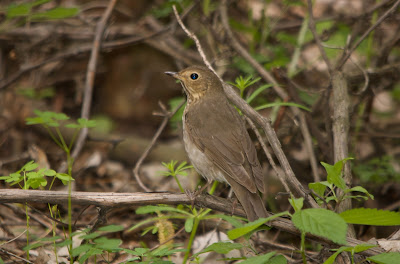
It was the singing of a Swainson’s Thrush that stopped me short, however. The fluting, smooth sound is rarely heard in this area since most of this species nests much further to the north. I followed the unmistakable sound of a thrush singing, deeper into the woods. And there he was, at eye-level, not 20 feet away. He seemed not to care that I was listening to his concert. His song was rolling and complex, not something I could whistle as I bushwhacked back to so-called civilization. It is a tune I’ll long remember, however.
Here’s what happened: I had to make a deposit at the bank (like they really need my money), which is about three miles from home if one wants to burn some fossil fuel. I was looking over a map, as I’m want to do, and decided it would be more fun to just head out through the woods, cut here, climb there, pop out on a trail near that spot and eventually work my way back to the parking area near the bank.
I grabbed my gear and went, fully expecting to do six or so miles round trip. The end of the story is that I did more than 10 miles. I sort of miscalculated all the twists and turns, and side trails to interesting sounds in the woods.
Getting off the beaten path is well worth the effort. I was in a park, in a metropolitan area and yet, the woods was as dense as one could wish for. A Hooded Warbler sang from a nearby bush. I stood still and he eventually worked to within 10 feet of where I watched him. Gorgeous views of a bird usually found in the tree tops. And more often heard than seen.
A Scarlet Tanager flash in front of me as I stopped to consider how wet I wanted to get crossing a creek. He landed on a branch on the other side and watched as I splashed through ankle-deep water, minnows scattering in all directions.
It was the singing of a Swainson’s Thrush that stopped me short, however. The fluting, smooth sound is rarely heard in this area since most of this species nests much further to the north. I followed the unmistakable sound of a thrush singing, deeper into the woods. And there he was, at eye-level, not 20 feet away. He seemed not to care that I was listening to his concert. His song was rolling and complex, not something I could whistle as I bushwhacked back to so-called civilization. It is a tune I’ll long remember, however.

Wednesday, May 06, 2009
Migration Madness

Here, along the north coast of America, neotropical bird migration is in full flight. We’re fortunate to have the premiere stopping spot for wood warblers, and other species, as they make their way to nesting grounds in Canada and beyond.
We joined the annual migration this past weekend at Magee Marsh in Ottawa County. As always, we headed to the spot where friends and birds will accumulate—the famous boardwalk trail. Some of us have been going there before the boardwalk was built and have thus earned the right to talk about the good old days when the birds virtually dripped from the trees. Well, I don’t exactly remember that, however, birders, like fishers, golfers and many others, tend to reminisce about things they aren’t really sure happened in the first place.
Not to put too fine a point on it, however, the birding was slow. In three days we tallied less than 100 species, not too hot by Magee Marsh standings. Birds, however, are only part of the story. For many, hitting the boardwalk during warbler migration season is as much a social event as anything else. A stroll through the parking lot can reveal license plates from at least half the states in the union—California to Maine to Florida to Texas. It’s an international event. The polyglot of languages can test your ear with French, German, Spanish, even New Jersian and Kentuckian.
I’ve seen days during migration when the best descriptive adjective would be frantic. Birds come at you from all directions and you need a visit to the chiropractor to get your head on straight. And while I like to tally as many of the colorful feathered gems as anyone, this year I appreciated the slower pace. It gave us a chance to study and appreciate the birds we did find—some uncommon to our area.
Our first morning, first bird was a Summer Tanager, not seen often in these parts. And the Veery, more often heard than seen, put on a great show. It was as if the birds sensed the slower pace, maybe less competition for food, and could afford to pose a bit and study the humans.

Wednesday, April 29, 2009
All’s Well That Ends

Our spur-of-the-moment, impromptu, fly-fishing trip to the East Coast, which we had been planning for about a year, got off to a rather auspicious beginning. Some whacky directions from the GPS unit I set up the day before proved the theory of “garbage in, garbage out.” Four days later the trip ended with a dead car battery. In between, things got real interesting.
All in all, for a fishing trip, the birding was wonderful.
We had been invited to a friend’s home on Cape Ann, Massachusetts. This drop-dead gorgeous spot sits right on the ocean, Ipswich Bay to be more precise. It carries the name Red Rock, because of the huge granite boulder that seems to anchor the entire spit of land where the classic thirties-era beach house rests.
We’ve been there before. In fact, we took our wedding trip there a decade ago. More than one striped bass has been caught and released in the surrounding waters. I’d not fished the salt for nearly three years, so I was looking forward to this trip. I spent the previous week tying fancy new flies for the occasion. Had I known one of those 2/0 Clousers was going to whack me in the back, I might have created something smaller.
Motoring south from Manchester, New Hampshire, Susan and I chattered away, not paying a lot of attention to road signs because: A, We knew where we were going, and B, we had the GPS. When the skyline of Boston loomed ahead, we knew something was amiss. Fortunately, Susan was driving and exited as soon as we realized we were going the wrong way. She stopped at the first convenience store so I could ask directions. When I had to explain to the lady behind the counter what a map was, I figured we were in real trouble.
We found our route, in spite of all the nasty things the GPS unit was saying and thinking.
Fishing on Thursday was a bit less than impossible. On Friday it got worse. The wind provided a gentle breeze of 30 knots, with gusts hitting 50 knots that could rip the flesh from your face. Not a chance of making a cast. But I tried, anyway. Two days into a four-day trip and I had hardly gotten a hook in the water.
Saturday the wind dropped and I headed for a favorite spot—after I figured out the tide movement thing. When you live in Ohio, all you have to know about Tide is that it comes in a box and you do the laundry with it. When you’re fishing in the ocean, you have to learn about tidal movement.

At “the spot” I noted that there was hardly another fisherman around. Two guys talking, not fishing, about 200 yards down stream. Not a good sign. I stepped off the bank to head out to the deeper water when I had my first near-death experience of the trip (neither gale force winds, getting lost, nor an over-priced lunch, count). What appeared to be relatively solid sand was muck with the texture of quicksand. Fortunately I was still near to the stream bank and was able to extract myself. Damage done? The Earth had reclaimed the soul of one wading boot and had ripped the other to the point where I’ll have to pry it off and get replacements. I think I also managed to add a couple inches to my overall height. Talk about something that sucks!
The two guys from down the way were now standing nearby. (Had I been screaming for help?) They were friendly locals and suggested I follow them to a better beach for some surf fishing. “Something wrong with the bottom here,” one of them offered. No kidding?
Saturday ended with high tide and a beach full of running kids and dogs. The chances of hooking either were good, however it might make for some bad PR for fisherman.
Back at the house, the simple task of disassembling my rod proved daunting. Sections two and three were jammed and were not about to be taken apart. I tried every trick in my near 40-year-old book of fly fishing knowledge to no avail. I was without computer access so Googling my plight was not possible. I called the good folks at L.L. Bean. They have a great fly fishing help line, 800-347-4552, that stays open until 10 p.m. for guys like me. I talked with anyone and everyone available. We tried every possible trick and still the rod would not separate. Well, finally it did. You don’t want to hear how. It’s too painful to even think about if you’re a fly fisher. Suffice to say, repairs are in order …
In hopes of cheering me, we opted for a lobster dinner. In this part of the world the lobster is relatively inexpensive—and alive. To get dinner on the table, a fight to the death must ensue. If you’re lucky, the guy with the biggest pinchers ends on the plate.
On Sunday, as I stared at my broken rod, I couldn’t help but think of what an ideal fishing day it would be—for someone. We switched gears, or gear, and went birding. Rewards were aplenty with great views of Savannah Sparrows, Brant, Long-tailed ducks, two species of scoters, and a couple of Blue Grosbeaks, particularly rare in this place and at this time.
Monday morning broke with the promise of another beautiful day. The downside was we had to head for Cleveland and our wonderful hostess, Cindy, had to get to work. What was beginning to look like a sad-faced good-by turned into a smiley faced opportunity. The good/bad news was that the battery in her car was deader than the lobster we had for dinner the night before. The fishing road trip got a reprieve and extension!

Did I mention that not a fish was caught? Or even seen? We did, however, log 59 species of birds, using only about seven gallons of gasoline.
Tuesday, April 21, 2009
It’s Justa Sparrow

Here’s one of those questions to which there is probably no answer: Why is it that a person with no binoculars and the ability to accurately identify only two birds—American Robin and Fried Chicken—feels compelled to educate the equipment-laden birder? And the corollary is: Why do I take it personally?
I was peacefully observing an outstanding alternate-plumaged White-throated Sparrow this morning along the trail when I was accosted, well that’s too strong of a word, bothered, by Mr. Knosmorthnu. He was out walking his dog. At least I think it was a dog. It looked more like a creampuff on a string. One of those dogs that appears to have run into a wall going top speed. If it was a kid, the grandmother would constantly be saying, “go blow your nose!”
Mr. K: “Whatcha lookin’ at?”
Okay, I admit, I was a bit high and pumped on adrenaline. It’s that time of the year. A birder’s nerves are on edge; every sense turned up to full-tilt-boogie. Figuring that I had the perfect opportunity to educate this chap, I said, “Well, it’s a …
Mr. K: “Oh, I see it. It’s justa sparrow.”
He started to yank on Puffy, or Muffy’s string and grumbled something about rain. I was not ready to let him go as yet. This dude certainly needed some education. I pushed on.
“It’s a White-throated Sparrow,” I said with my know-it-all authoritarian voice.
Mr. K: “Who cares? They’re all alike. Seen one ya seen ‘em all. Brown birds.”
I couldn’t help myself. I said, “Yeah, just like dogs. All alike.”
He gave me a strange look and pulled the dog in closer to his side. I don’t know if he was protecting the dog or guarding himself. He quickly moved on. I noticed he glanced over his shoulder at me several times.
I wanted to tell him sparrows are not all alike. Depending on how you count, we have at least 20 species in this area with sparrow in their name. Toss in the juncos, towhees and other relatives and their family reunion can be quite an interesting, and colorful event.
With all the positive energy flowing, I told myself it’s okay; he’s outside enjoying the trail. And he's paying his taxes so others can enjoy the trail, too.
I should have said, up front, it's never justa sparrow.
Saturday, April 18, 2009
What’s Old is New Again

The Cuyahoga Valley National Park has a lot of hidden treasures. Many you have to get off the trail, or at least out of your car, to find. Some are so obvious that thousands of people drive by without giving them a second , maybe a first, thought. One I rediscovered is Wilson’s Mill, located on Canal Road in Walton Hills.
This feed mill is a working operation, unlike many of the “exhibits” in the park, which are only relics to educate people on how life was 150 years ago. We stopped in at the mill a few days ago so that Susan could buy some supplies for the bird-feeding stations where she works. While she was talked with the owners, I roamed around the interior.
I’ve read someplace that there are 60 million people in the U.S. who consider themselves birders, or at least feed wild birds sometime during the year. From the looks of the interior of Wilson’s Mill, I think about half that number must buy supplies here. Then there are supplies for virtually all the other two- and four-legged creatures.
The cramped quarters inside this building, built in either 1855 or 1853 depending on which historical text you read, is lined with bird feeders and paraphernalia. I tried counting the number of bird feeders hanging from the ceiling and gave up when I hit 100.
There are no straight aisles inside the store. Neither are there any software hands in the hardware store, as John Gorka says. These are working people. The kind of guys who put a 50-pound bag of seed on each shoulder and carry it out to your car for you—with a smile and a thanks attached.
The mill’s original name was Alexander’s Mill, built to grind wheat into flour. It was built at Lock 37 on the canal and used water from the nearby Cuyahoga River to drive (and here history is a bit clouded as to the style of power generator) the grid stones. It probably used the typical over-shot under-shot style waterwheel. The mill converted to turbines in the late 1800s. This was the last mill in Cuyahoga County to use water for power, and continues as the only mill in the county.
Pieces and parts of those old turbines are still in place, mostly for nostalgic reasons. As I watched the sun come up over the eastern ridge of the valley one morning, I looked at one of those structures and could not help but think that maybe its time has come again: Free power to the people.
Give me the warm power of the Sun.
Give me the steady flow
of the waterfall.
Give me the spirit of living things
As they return.
Thanks, Doobie Brothers and James Taylor.
Sunday, April 12, 2009
The Birding Blues
Birders in Ohio and surrounding states have got themselves into a lather this week with confirmation of a Mountain Bluebird in our state. The cooperative bird (at this writing) is located near Oak Openings, not far from Toledo and an outstanding birding location. People from all over have been flocking to the spot to see this gorgeous critter; only the second time it’s been recorded in our state.
Susan and I kicked around the idea of going over to see it, however, common sense prevailed and we spent the day closer to home. We’ve both seen the Mountain Bluebird in its natural habitat, and the thought of 10 hours in the car on such a pretty day seemed a bit daunting.
We found all the shades of blue in the Cuyahoga Valley National Park, our 33,000 acre backyard. We first stopped at the Beaver Marsh where Tree Swallows have returned in abundance. Their iridescence sparkled as they seined the air for bugs we could not see.
Our next stop was the heron rookery on Bath Road. Things were on the quiet side, compared with only a week ago when the Great Blue Herons were pairing off, gathering nesting material and, I suppose, catching up on local gossip. Today we watched one clever male extract a stick from a jumble of grape vines and offer it to his mate. The stick was apparently to her liking because she tucked it into the nest.

We ended the day with a hike around the Bath Nature Preserve. People have already been reporting Eastern Meadowlarks from this spot, however, we could find none. Our attention was drawn, time and again, to the brilliant Eastern Bluebirds.
Blue skies and blue birds. Certainly days like this are a cure for the blues.

Susan and I kicked around the idea of going over to see it, however, common sense prevailed and we spent the day closer to home. We’ve both seen the Mountain Bluebird in its natural habitat, and the thought of 10 hours in the car on such a pretty day seemed a bit daunting.

We found all the shades of blue in the Cuyahoga Valley National Park, our 33,000 acre backyard. We first stopped at the Beaver Marsh where Tree Swallows have returned in abundance. Their iridescence sparkled as they seined the air for bugs we could not see.
Our next stop was the heron rookery on Bath Road. Things were on the quiet side, compared with only a week ago when the Great Blue Herons were pairing off, gathering nesting material and, I suppose, catching up on local gossip. Today we watched one clever male extract a stick from a jumble of grape vines and offer it to his mate. The stick was apparently to her liking because she tucked it into the nest.

We ended the day with a hike around the Bath Nature Preserve. People have already been reporting Eastern Meadowlarks from this spot, however, we could find none. Our attention was drawn, time and again, to the brilliant Eastern Bluebirds.
Blue skies and blue birds. Certainly days like this are a cure for the blues.

Tuesday, April 07, 2009
Finding Closure
Back in December I wrote about a Canada Goose Susan and I spotted during our day of counting birds as part of the Greater Akron Audubon Society's participation in the Annual Christmas Count. The bird was tagged 2E1R with a neck collar the size of a soda can.
Who was 2E1R? We now know, thanks to the good folks at the U.S. Geological Survey (www.pwrc.usgs.gov). These are the people you report banded birds to.
What we knew then was that he (an assumption we made about sex that turned out to be correct) was a Canada Goose, most likely from the Common population (of which there are at least six recognizable populations), and he was big. He looked to be the full 45 inches in length and his wingspan of 60 inches fit the pattern.
Yesterday I received a Certificate of Appreciation from USGS for helping it with its North American bird banding program. Turns out that 2E1R was tagged June 23, 2003 in Willoughby, Ohio, by Nathan Strickler of the Ohio Division of Wildlife. 2E1R was a juvenile bird in those days, too young to fly.
About 58 million birds representing hundreds of species have been banded in North America since 1904. More than 3.1 million bands have been recovered and reported. Data from the banded birds are used in monitoring populations, setting hunting regulations, restoring endangered species, studying the effects of environmental contaminants and many other issues.
Among birders, the banding process is one of those things that gets hotly debated; good for the scientists—stressful to the birds, etc. No doubt, a few birds do die in the process. I think, however, in general the birds—and the humans—are better for the banding.

In May 2008 Susan and I, along with a group from the Cleveland Museum of Natural History, were in Madera Canyon, Southwest Arizona, on a birding/astronomy adventure. We watched in fascination as wildlife artist/bird-bander George West attached microscopic-size bands to the legs of humming birds. I wondered if—how—anyone would ever find those bands given the fact that the bird was the size of his thumb. George said much of the benefit comes from recapture of the bird, not finding the band when the bird is dead.
The more we know, the more we know we don't know all that much. And that's good to know, too.
Who was 2E1R? We now know, thanks to the good folks at the U.S. Geological Survey (www.pwrc.usgs.gov). These are the people you report banded birds to.
What we knew then was that he (an assumption we made about sex that turned out to be correct) was a Canada Goose, most likely from the Common population (of which there are at least six recognizable populations), and he was big. He looked to be the full 45 inches in length and his wingspan of 60 inches fit the pattern.
Yesterday I received a Certificate of Appreciation from USGS for helping it with its North American bird banding program. Turns out that 2E1R was tagged June 23, 2003 in Willoughby, Ohio, by Nathan Strickler of the Ohio Division of Wildlife. 2E1R was a juvenile bird in those days, too young to fly.
About 58 million birds representing hundreds of species have been banded in North America since 1904. More than 3.1 million bands have been recovered and reported. Data from the banded birds are used in monitoring populations, setting hunting regulations, restoring endangered species, studying the effects of environmental contaminants and many other issues.
Among birders, the banding process is one of those things that gets hotly debated; good for the scientists—stressful to the birds, etc. No doubt, a few birds do die in the process. I think, however, in general the birds—and the humans—are better for the banding.

In May 2008 Susan and I, along with a group from the Cleveland Museum of Natural History, were in Madera Canyon, Southwest Arizona, on a birding/astronomy adventure. We watched in fascination as wildlife artist/bird-bander George West attached microscopic-size bands to the legs of humming birds. I wondered if—how—anyone would ever find those bands given the fact that the bird was the size of his thumb. George said much of the benefit comes from recapture of the bird, not finding the band when the bird is dead.
The more we know, the more we know we don't know all that much. And that's good to know, too.
Think Spring

Here in Northeast Ohio, the American Goldfinches, like the rest of us, assumed that because we had one of the warmer month’s of March on record, it was time to toss off the drab winter coats and get ready for spring. Time to clean the closets and get ready for visitors coming out of hibernation. Maybe even head north for spring break.
Nature can be a cruel mother, and April is her month to shine. Bright sunny days turn to sleet and rain; rain to snow and snow to …
Well, snow turns to some beautiful photo opportunities, if nothing else. It’s the kind of weather we hope for in November. Gorgeous outlines on the trees; ugly brown leaves covered and the streets remain clear, if only a bit wet.
One of these years we’ll figure it all out. For now, however, it’s time to enjoy the beauty of snow, which is also part of spring.
Wednesday, April 01, 2009
A Bird in the Nest is Worth …
I was trying to explain my excitement of recently finding a Red-shouldered Hawk’s nest to a non-birding friend. He didn’t get it. His response was, as best I recall, “What’s the big deal? Isn’t that where birds are supposed to be? In the nest?”
Well, sort of. We’re well into the time of year when some of the larger birds—owls, hawks and others—are on the nest, even feeding young in some cases. The time a bird spends “on the nest” is actually quite short. Depending on the species it can range from a couple weeks to almost a month that one of the parents is on the nest, incubating the eggs. And the bird’s instinctive thermostat tells him or her when the eggs might need a bit of cooling. Plus, you have to eat, so time on the nest can be interrupted.
Then, with all those hungry mouths to fill, it’s virtually non-stop activity for weeks as the adults come and go with the variety of food stuffs for the young. Some birds are easier to observe, like eagles and Osprey bringing home the bacon—or a nice fish dinner in the case of these two. What’s for dinner is more of a challenge with other species.
Take hummingbirds, for example. If you can even find the silver-dollar-size nest you’ve made a major discovery. And to watch an adult, usually the female, coming in with microscopic bugs or whatever for the young is a bonus. The real treat of watching an adult hummingbird feed the young is to see that incredibly long beak slide into the youngster’s throat. The beak looks longer than the bird.

On a recent trip to California Susan and I found two Allen’s Hummingbirds nesting. These three-gram dynamos have no fear. In one instance, we stood directly beneath the nest while the female came and went with who-knows-what for her youngster. The youngster seemed too large for the tiny nest and was more interested in licking the underside of the leaves of the live oak where it nested.
Certainly all the trappings of nesting season provide birders with excitement and challenges, however, seeing the end result—a bird on the nest—can bring new and different rewards.
Well, sort of. We’re well into the time of year when some of the larger birds—owls, hawks and others—are on the nest, even feeding young in some cases. The time a bird spends “on the nest” is actually quite short. Depending on the species it can range from a couple weeks to almost a month that one of the parents is on the nest, incubating the eggs. And the bird’s instinctive thermostat tells him or her when the eggs might need a bit of cooling. Plus, you have to eat, so time on the nest can be interrupted.
Then, with all those hungry mouths to fill, it’s virtually non-stop activity for weeks as the adults come and go with the variety of food stuffs for the young. Some birds are easier to observe, like eagles and Osprey bringing home the bacon—or a nice fish dinner in the case of these two. What’s for dinner is more of a challenge with other species.
Take hummingbirds, for example. If you can even find the silver-dollar-size nest you’ve made a major discovery. And to watch an adult, usually the female, coming in with microscopic bugs or whatever for the young is a bonus. The real treat of watching an adult hummingbird feed the young is to see that incredibly long beak slide into the youngster’s throat. The beak looks longer than the bird.

On a recent trip to California Susan and I found two Allen’s Hummingbirds nesting. These three-gram dynamos have no fear. In one instance, we stood directly beneath the nest while the female came and went with who-knows-what for her youngster. The youngster seemed too large for the tiny nest and was more interested in licking the underside of the leaves of the live oak where it nested.
Certainly all the trappings of nesting season provide birders with excitement and challenges, however, seeing the end result—a bird on the nest—can bring new and different rewards.
Monday, March 16, 2009
Life is Golden

As Lance Armstrong says, “There are no bad days. Some days are just better than others.” That holds true when birding outstanding places like Killdeer Plains near Harpster, Ohio (40.42’09 N 83.17’35 W).
On our annual winter birding trip to the wildlife area, Susan Jones and I, along with our friends Karin Tanquist and Pat Coy, fully anticipate finding three, maybe four species of owls. It’s almost a tradition that we find wintering owls there. This year, on March 15, it was not to be. One species, Short-eared Owl, was all we could locate.
The unbelievable news is that we saw not one, but two Golden Eagles, along with a plethora of Bald Eagles. In fact, we had more eagles than sparrows.
Golden Eagles are somewhere between rare and unheard of in this part of Ohio. Occasionally, like this past winter, one will show up at the Wilds in east-central Ohio. We went there in January to see it. The temperature was a balmy minus 14 that day and through frozen eyeballs we saw the bird about three miles distant.
Yesterday was a different story. It was Pat who first spotted the juvenile golden. We’re all better-than-average birders, so, as he calmly talked through the identifying marks of a bird miles away, visible only through his spotting scope, we were all coming to the same conclusion. As we all got our scopes on the bird, two Bald Eagles rose to meet their larger cousin. The three put on an aerial display that had us oooing and aaaaing like it was the Fourth of July. (In the photo, the top bird is a Bald Eagle, as is the one on the left. The larger, Golden Eagle is on the right.) After what seemed like an hour, however, it was probably only 10 minutes, of soaring, the three birds parted company. As we kept looking, afraid to take our eyes off the spot, in amazement, another huge dark shape came into view. An adult Golden Eagle! The lighting was so good that it was the first time any of us clearly saw the spectacular shade of gold on the bird’s head for which it is named.
Some days are just better than others. March 15 was one of those for us birders. For documentation I’m posting these two photos. For a larger view, click on the photo.

Monday, March 09, 2009
Global Warming

Right, global warming. It’s been a tough sell for the concept of global warming this winter in northeast Ohio. We’ve had so many Pine Siskins at our feeders this season—a bird we rarely see—that I’m ready to write these critters a check instead of hauling that seed out every day. Then, the White-wing Crossbills showed up in such overwhelming numbers that birders throughout the state were hyperventilating. Now, signs of love are in the air of the avian world. For example, two Downy Woodpeckers that have been regular singles at our feeders all winter, showed up the other day as a pair. The male was all cleaned and polished and showing off his best and most-attentive manners to the female. She seemed responsive to all the flattery as well.
There’s almost as much science for global warming as against it. I recently read that the North Atlantic is forecast to be in a cold pattern for the next 10 years or so, meaning things might cool down. Will that bring the glaciers back to Glacier National Park? Will it close the holes in the Arctic Ocean and bring back polar bear habitat? Probably not. Will it slow down the warbler migration we were more accustom to seeing in mid-May rather than late April as has been the case for the past several years? Who knows.
If you enter the subject of global warming into your favorite search engine, you get about two million pages on the subject; multiply that times 10 for the number of listings per page and it’s mind boggling—and those are just references to the real books and articles.
I’ve come to the conclusion that global warming—or the threat thereof—has been a good thing, regardless of its validity. It has caused the world to focus more on how we use—or misuse—fossil fuels. It has made more people aware of the environment and human impact on the animals and plants that share this limited rock we call Earth. It has focused engineering on reusable energy sources, which in the long run will make this a better place for my grandkids whom I can regale with stories of how tough it was when I was kid.
So, the time being, let’s emulate the birds and think love and peace for a while.
Tuesday, February 10, 2009
Signs of Spring
After yesterday’s challenging hike in the national park, where snow still dominates the trails in spite of our Spring-like temperatures, today I opted for something a bit less physical. I headed for the bike-and-hike trail that offers relatively good birding and lots of flat pathways.
Turns out there was a challenge of a different sort. A friend used to say, “When winter’s snow melts, the first signs of Spring; the first things to come up, are cigarette butts and dog shit.” Oh, so true.
Navigating around the telltale brown piles and not slipping on the melting ice proved worthy of the category—challenging.
This was all offset by the first dawn chorus of the season. The musical was dominated by Northern Cardinals in their cheerleader-red outfits. Close behind were the many Pine Siskins that have been wintering in the Cleveland area, finding it more to their liking than the Arctic tundra. The chickadees and titmice, which sing year round, were vocal as usual. Song Sparrows and American Tree Sparrows were joined by an occasional Field Sparrow and melodic White-throated Sparrows. Percussion was ably handled by Down Woodpeckers with the occasional drumming of a Red-bellied Woodpecker. A laughing commentary was offered by a pair of out-of-sight Pileated Woodpeckers. A voice I do not usually hear in the dawn chorus turned out to be a Cooper’s Hawk. When the Carolina Wren jumped in with his part, things really got hopping. Song Sparrows I had not noticed began to sing. I even heard a few tentative notes from the resident Northern Mockingbird, which signaled to another mockingbird I had not seen, to jump up and take notice. When I reached the 2.5 mile point I sat down to just listen and quit fighting the ankle-twisting ice—and the afore mentioned poop. I dug deep into my daypack for that energy bar that’s been in there someplace, all Winter. I found it. Damn! Turns out to have peanut butter in it and I know it’s on the recall list.
The words of (I think) singer Robbie Roberson, formerly of The Band, came ringing through. He once told a class of graduating college seniors to, “Watch what you eat and where you step.” Still good advice.
Turns out there was a challenge of a different sort. A friend used to say, “When winter’s snow melts, the first signs of Spring; the first things to come up, are cigarette butts and dog shit.” Oh, so true.
Navigating around the telltale brown piles and not slipping on the melting ice proved worthy of the category—challenging.
This was all offset by the first dawn chorus of the season. The musical was dominated by Northern Cardinals in their cheerleader-red outfits. Close behind were the many Pine Siskins that have been wintering in the Cleveland area, finding it more to their liking than the Arctic tundra. The chickadees and titmice, which sing year round, were vocal as usual. Song Sparrows and American Tree Sparrows were joined by an occasional Field Sparrow and melodic White-throated Sparrows. Percussion was ably handled by Down Woodpeckers with the occasional drumming of a Red-bellied Woodpecker. A laughing commentary was offered by a pair of out-of-sight Pileated Woodpeckers. A voice I do not usually hear in the dawn chorus turned out to be a Cooper’s Hawk. When the Carolina Wren jumped in with his part, things really got hopping. Song Sparrows I had not noticed began to sing. I even heard a few tentative notes from the resident Northern Mockingbird, which signaled to another mockingbird I had not seen, to jump up and take notice.
When I reached the 2.5 mile point I sat down to just listen and quit fighting the ankle-twisting ice—and the afore mentioned poop. I dug deep into my daypack for that energy bar that’s been in there someplace, all Winter. I found it. Damn! Turns out to have peanut butter in it and I know it’s on the recall list.The words of (I think) singer Robbie Roberson, formerly of The Band, came ringing through. He once told a class of graduating college seniors to, “Watch what you eat and where you step.” Still good advice.
Tuesday, January 20, 2009
Inauguration Bird
I was driving north on I-77 this afternoon, listening to President Barack Obama's inaugural address. Movement to my left caught my eye. I glanced up and saw a mature Bald Eagle wheeling and turning in the sun-filled sky above me. The brilliant white head and tail, combined with the shining brown body to create a true symbol of America. What a great way to begin the Obama era.
Thursday, January 15, 2009
Winter Treat

Along with the Arctic blast of cold weather, a special visitor arrived at our feeders today. A Common Redpoll (which is not all that common) was mixed in with a flock of Pine Siskins. Always a pleasure to see one of these little guys. It's just too bad we have to deal with the four-degree temperatures as well.
Monday, January 12, 2009
Wintering On The North Coast of America

Finally the big snow the weather prognosticators had been promising, arrived. I don't want to say the snow is deep, however, I took this picture of a grizzly bear from my front window to give you a feel for how deep it is.
Friday, January 09, 2009
It’s Raining Starlings!

There’s a school of thought in the nature world that birds and other animals predict impending storms and thus eat as much as they can in case they can’t get out during inclement weather. How they do this without benefit of the Weather Channel remains a mystery to ornithologists.
Here, on the North Coast of America, we’re awaiting, with bated breath, for a storm to whack us. The Weather Channel and the local weather prognosticators have been predicting inches of snow, blustery winds and weather chaos in general for the next couple days.
I took a break from my chores to monitor the bird feeders around mid morning and was astonished at the number of European Starlings covering the ground. I Guessitimated about 100 but was probably wrong. Mixed in with the starlings were American Robins.
The birds were in a feeding frenzy, attacking the seed feeders and, especially, the two suet cakes. I checked the water dish and there was four-bird deep waiting line! The trash truck arrived and the birds scattered. Only then did I see there were several squirrels on the ground also tanking up for the big storm. When the trash guys left, the birds returned, however, there were not as many. And the starlings were joined by a half dozen Cedar Waxwings, a single male Northern Cardinal—I mean he was unaccompanied, not his marital status—a number of Dark-eyed Juncos and most of the other feeder birds. When the female Red-bellied Woodpecker arrived to dine on her favorite suet block, I sensed trouble. Three starlings were squabbling over the suet already. She landed on the top of the pole that holds the suet and just stared the three speckled intruders down. It appeared they were taking measure of her beak and decided it might not be a fair dust-up if they continued. Off they went.
So what does this all mean? A dozen or so species of birds and assorted squirrels chowing down, all more-or-less in harmony; getting ready for the storm. There’s probably some ancient message here that we humans can’t seem to tune into. We seem to do a fair job of handling the disaster after it happens …
I think I’ll go make sure the snow shovel is near the door—and that we have an adequate supply of cookies for the weekend.
Thursday, January 08, 2009
I Thought I Saw …
People around Cleveland either love winter or hate it. There seems to be no middle ground. I enjoy the snow and constantly changing views during a snow storm, so I set the laptop on the table overlooking our bird feeder array in hopes of getting some necessary work done—along with some quality time watching the birds come and go. I was about half successful.
Late this afternoon things were as busy as the Starbucks down the street, only my customers were all the fur and feathered types. No fewer than 20 Pine Siskins were on the feeders, along with some of the brightest-colored juncos I’ve seen this season. Black-capped Chickadees, titmice and no fewer than four species of woodpeckers added the occasional spot of red to the black-and-white winter tableau.
I glanced down at the screen to see if I had written anything and in a flash, all the birds disappeared. Out of the corner of my eye I caught a glimpse of the resident Cooper’s Hawk flashing overhead.
After a quiet period of a couple minutes the birds trickled back by ones and twos. Chickadees first, followed by House Finches, a single White-throated Sparrow and even some American Robins came to feed on the fruits of the Bradford Pear tree.
About the time the number of birds was back up to where it had been, the hawk flashed though again. This time it was so low to ground I could not believe it’s wings were not hitting the snow. Equally as fast the birds all disappeared, except for a Downy Woodpecker that was hanging to the block of suet. He probably thought he was out of the hawk’s line of vision. He glanced around the suet to be sure the hawk was gone.
This scene repeated itself two more times. The hawk made no attempt to strafe the feeder as I’ve seen it do in the past. So I’m left to try to figure out its strategy. It might have been demonstrating its ability to fly incredibly fast and low; work off some extra ounces gained over the holidays; or show all the other birds it’s really a good guy—in spite of what they might have heard about hawks dining on small birds.
I’m sure one of my naturalist friends has an explanation for this behavior, but why let the facts get in the way of a good story?
Late this afternoon things were as busy as the Starbucks down the street, only my customers were all the fur and feathered types. No fewer than 20 Pine Siskins were on the feeders, along with some of the brightest-colored juncos I’ve seen this season. Black-capped Chickadees, titmice and no fewer than four species of woodpeckers added the occasional spot of red to the black-and-white winter tableau.
I glanced down at the screen to see if I had written anything and in a flash, all the birds disappeared. Out of the corner of my eye I caught a glimpse of the resident Cooper’s Hawk flashing overhead.
After a quiet period of a couple minutes the birds trickled back by ones and twos. Chickadees first, followed by House Finches, a single White-throated Sparrow and even some American Robins came to feed on the fruits of the Bradford Pear tree.
About the time the number of birds was back up to where it had been, the hawk flashed though again. This time it was so low to ground I could not believe it’s wings were not hitting the snow. Equally as fast the birds all disappeared, except for a Downy Woodpecker that was hanging to the block of suet. He probably thought he was out of the hawk’s line of vision. He glanced around the suet to be sure the hawk was gone.
This scene repeated itself two more times. The hawk made no attempt to strafe the feeder as I’ve seen it do in the past. So I’m left to try to figure out its strategy. It might have been demonstrating its ability to fly incredibly fast and low; work off some extra ounces gained over the holidays; or show all the other birds it’s really a good guy—in spite of what they might have heard about hawks dining on small birds.
I’m sure one of my naturalist friends has an explanation for this behavior, but why let the facts get in the way of a good story?
Friday, December 19, 2008
The Joys of Winter
The pine tree next to and above our bird feeder array was genuflecting to the gods of winter. A mix of rain, ice and snow wrapped its needles in crystalline cocoons. Our usual suspects were feeding with a frenzy at all the feeders and on the ground. Nine species, one food source, no fighting. It seems the bad weather brings out the best birds—as well as the best in birds.
The squirrels, of which we have too many, though their variety this year is better than at other times, were challenged by the ice. Fitting that well-used definition of insanity, which also applies to fly fishing, they were doing the same thing, over and over, expecting different results. Grey, red, black and brown, the kaleidoscope of squirrel fur went up the trunk of the tree, out onto the branch and, zippppp! They would either grasp in desperation for the hook that held the feeder, or accept their plight and imitate their cousins, the flying squirrels, and try to make a graceful landing.
Because I had to go out, I was hoping the ice storm would end. Because I was enjoying one of nature’s greatest shows on ice, I was considering another cup of coffee.
The squirrels, of which we have too many, though their variety this year is better than at other times, were challenged by the ice. Fitting that well-used definition of insanity, which also applies to fly fishing, they were doing the same thing, over and over, expecting different results. Grey, red, black and brown, the kaleidoscope of squirrel fur went up the trunk of the tree, out onto the branch and, zippppp! They would either grasp in desperation for the hook that held the feeder, or accept their plight and imitate their cousins, the flying squirrels, and try to make a graceful landing.
Because I had to go out, I was hoping the ice storm would end. Because I was enjoying one of nature’s greatest shows on ice, I was considering another cup of coffee.
Wednesday, December 17, 2008
I’m Turning You In
He didn’t look like a criminal. I knew his whereabouts, however, was important and needed to be reported to the proper authorities. He wasn’t even acting like a bad guy, yet, I knew it was my civic duty to report his location, even if I had to take time from my hectic schedule that included a nap and some catching up on that stack of magazines on the table.
He was hanging out with a bunch of his type, all wearing the same colors. They hadn’t spotted Susan and I as we used the car as a blind. Or, maybe they had spotted us and, because they’re such a rough bunch, ignored us knowing their superior numbers made it a certain victory for their side should we attempt anything funny—like a citizen’s arrest for example.
Susan lowered her window. Chilling wind and rain whipped her in the face. She raised her binocular and gave me the description. I took extensive notes on the back of a freebie parking pass from the Cleveland Museum of Natural History. “It’s white,” she said softly as she strained to see through the lashing drizzle, trying to read the numbers. “Okay, got it. It’s 2E1R, black letters arranged vertically.”
Who was 2E1R? This much we could discern: He was a Canada Goose, most likely from the Common population (of which there are at least six recognizable populations), and he was big. He looked to be the full 45 inches in length and his wingspan of 60 inches fit the pattern.
The white collar on his neck looked like a soda can. In fact, the first time I saw one of these tags on a goose, way back in the last century when I was a beginning birder, it was red and I thought it was a soda can.
So there he was, grazing with about 300 of his kind. His tag, or collar, attracted about as much attention as a tattoo on a human these days. The more I looked at the goose and thought about him carrying that tag for life, the more it did seem like a tattoo, only this marking has a purpose attached; it’s not a wannabe fashion statement.
He’s part of someone’s research project and needed to be reported. The way to do it, should you encounter a goose with a collar or any bird with a band on its leg, is to go to www.pwrc.usgs.gov/BBL/homepage/call800.cfm, the Web site of Patuxent Wildlife Research Center, where data is collected. If you leave your e-mail address they might get back to you with information about the bird you’ve seen. I’m hoping to learn more about 2E1R. If I do, I’ll let you know. In the meantime, feed the birds. It’s cold out there.
And as for you 2E1R, you’re now in the computer, buster, so just watch your step, or where others might step.
He was hanging out with a bunch of his type, all wearing the same colors. They hadn’t spotted Susan and I as we used the car as a blind. Or, maybe they had spotted us and, because they’re such a rough bunch, ignored us knowing their superior numbers made it a certain victory for their side should we attempt anything funny—like a citizen’s arrest for example.
Susan lowered her window. Chilling wind and rain whipped her in the face. She raised her binocular and gave me the description. I took extensive notes on the back of a freebie parking pass from the Cleveland Museum of Natural History. “It’s white,” she said softly as she strained to see through the lashing drizzle, trying to read the numbers. “Okay, got it. It’s 2E1R, black letters arranged vertically.”
Who was 2E1R? This much we could discern: He was a Canada Goose, most likely from the Common population (of which there are at least six recognizable populations), and he was big. He looked to be the full 45 inches in length and his wingspan of 60 inches fit the pattern.
The white collar on his neck looked like a soda can. In fact, the first time I saw one of these tags on a goose, way back in the last century when I was a beginning birder, it was red and I thought it was a soda can.
So there he was, grazing with about 300 of his kind. His tag, or collar, attracted about as much attention as a tattoo on a human these days. The more I looked at the goose and thought about him carrying that tag for life, the more it did seem like a tattoo, only this marking has a purpose attached; it’s not a wannabe fashion statement.
He’s part of someone’s research project and needed to be reported. The way to do it, should you encounter a goose with a collar or any bird with a band on its leg, is to go to www.pwrc.usgs.gov/BBL/homepage/call800.cfm, the Web site of Patuxent Wildlife Research Center, where data is collected. If you leave your e-mail address they might get back to you with information about the bird you’ve seen. I’m hoping to learn more about 2E1R. If I do, I’ll let you know. In the meantime, feed the birds. It’s cold out there.
And as for you 2E1R, you’re now in the computer, buster, so just watch your step, or where others might step.
Monday, December 01, 2008
… And Not in Hand

Previously, I wrote about the close encounter Susan and I had with Northern Saw-whet Owls in Ross County. Petting an owl on the back of the head is an experience the defies description. You really do have to be there.
There are, however, other aspects to birding that even when you are there you hardly believe your eyes. The occasional view of birds from the car can have its challenges, and its rewards. For example, after our night at the banding station near Chillicothe, plenty of adrenaline and less-than-perfect rest in the No-Tell Motel, we headed north for home in an early drizzle of rain and snow. We opted to stay off the interstate highways and see a bit of Ohio’s rural charm. It’s a great experience and the only known cure for white-line fever. Passing through places that are slightly more than wide spots in the road, yet are birth places to Civil War generals or presidents, gives you a sense of connection not found out there battling with 18-wheelers.
Heading north on State Route 83 in Holmes County, Susan suddenly shouted, “sandhills!” There, high on a hill in the middle of a mowed field stood four Sandhill Cranes. After some maneuvers with our Saturn that might have been more easily accomplished with a VW bug, we zipped up a curving, one-way drive, around some out buildings and reached the top of the hill. Rats! The birds were blocked by a rise in the field we had not noticed. Before the residents of the nursing home (as we discovered it to be) could figure out what we were up to, we were flashing down the drive, back out onto the highway and looking for another angle to see the cranes.
We spotted a semi-paved road that should lead to the top of the hill and a possible view from the other side. As we pulled into a parking area at the top I noticed the building was a kind of semi-official looking. Susan was out of the car, binocular in hand, before I had come to a full stop. I was digging out a camera (Why is the wide-angle lens always on when you need the telephoto?) trying not to drop any expensive glass, nor strangle myself with a binocular strap caught in the door.
I dashed through the trees where Susan had gone. There they were, about 50 yards away. Two adult and two juvenile Sandhill Cranes. They looked at us through the drizzle, looked at each other, and in that way birds have of communicating without saying anything, lifted off in unison.
The beauty and grace of the birds is, in part, because of their size. It takes some effort to get that huge body elevated. The huge wings unfolded, and because of our nearness, we could see the wings ripple rather than flap. When they do take flight, we humans can only stand and watch and wonder what it must be like.
We walked back to the car, chattering like a couple of sparrows about our close encounter. I glanced up at the building where we had parked—not exactly between the white lines. It was the Holmes County Jail. I wondered if the prisoners had seen us or the birds that so freely flew from perceived danger.
Bird in the Hand

I’m frequently asked why I’m a bird watcher. Well, “watcher” is hardly what it’s all about any more. This past weekend, Susan and I spent a spectacular evening/night in Chillicothe, Ohio, with Kelly Williams-Sieg, a master bird bander. Kelly’s working on her PhD, documenting (along with a network of others) the migration of Northern Saw-whet Owls through Ohio. These little creatures, about the size of the palm of your hand, are little known in this area. All that is changing. Kelly started banding the birds in 2003 at the Earl H. Barnhart Buzzard’s Roost Nature Preserve in Ross County—and the body of knowledge grows a bit every night from October to January.
Bird banding is a demanding sport. Banding owls takes that to another level. Although Kelly says the nip of a Northern Cardinal can be more painful than a saw-whet, the owl’s primary tool, its talons, demand a lot of respect.
When we weren’t climbing or descending the hills checking the nets, we sat and watched a glorious sky, filled with more stars than you believe possible. Orion, in his warrior garb, slowly lifted as we sat and talked about birds and this small piece of a much larger puzzle. The sky was so filled with stars on this near-moonless night, that all the regular constellations were a challenge to find. The 30-degree temperatures were not even an issue.
After a couple hours of checking the nets we hit pay dirt. Or rather a female saw-whet hit the net. This owl must like the Ohio countryside. It was a repeat. Kelly had banded this girl in October. The owl still got her check-up to see if she was gaining weight, etc.
It was amazing to see how the owl accepted all of our probing and photographing. She seemed as curious about us as we of her. When we finally released her I could not help wonder if, when she returns to her own kind, does she tell them the tale of her second alien abduction in as many months; and how she was examined by these friendly creatures with long limbs and no feathers …
Thursday, November 27, 2008
What’s For Dinner?
Humans have much to be thankful for on this day. Many of nature’s other critters do, also. I suppose the thing they are most grateful for—on any given day—is that they are not on the menu.
The Bald Eagle was spared the oven and the Wild Turkey was not. So, what does the eagle have for dinner on this day? Susan and I spent the morning at Burke Lakefront airport in downtown Cleveland, along with a few other intrepid birders. And while we all noted that our holiday behavior was normal, we wondered what those people on the three sailboats were thinking. We were there to check on a gorgeous visitor from the Arctic—a snowy owl. By its mottled gray coloring we’re assuming it’s youngster. Through the spotting scopes we could see its yellow eyes set in the white disk of its face, and its huge feet when it scratched behind its ears. It seemed little concerned about the airplanes that passed within a few feet of its position at the end of the runway.
Oh, this was supposed to be about eagles and Thanksgiving dinners. After checking the billions of Bonaparte’s Gulls at the nearby marina, hoping for something out of the ordinary, we spotted an eagle heading straight at us from the vicinity of downtown. As it circled, gaining altitude, we realized it had something in its talons. It eventually passed almost directly over us. We could see it was preparing dinner as it moved. Feathers from its prey fluttered away in a continuous stream. It turned slowly, not unlike a Boeing 747, and came in for a landing in the grass at the end of the runway, almost opposite our position. It only pecked at its meal and appeared to be resting. Then, with great effort, it took off, heading east. We debated what was on the menu this day for the Bald Eagle. Maybe a duck; maybe a pigeon. Judging from the amount of blood we could see on its massive beak, we hoped it did not have too large of a family to feed when it got to where it was going.
The Bald Eagle was spared the oven and the Wild Turkey was not. So, what does the eagle have for dinner on this day? Susan and I spent the morning at Burke Lakefront airport in downtown Cleveland, along with a few other intrepid birders. And while we all noted that our holiday behavior was normal, we wondered what those people on the three sailboats were thinking. We were there to check on a gorgeous visitor from the Arctic—a snowy owl. By its mottled gray coloring we’re assuming it’s youngster. Through the spotting scopes we could see its yellow eyes set in the white disk of its face, and its huge feet when it scratched behind its ears. It seemed little concerned about the airplanes that passed within a few feet of its position at the end of the runway.
Oh, this was supposed to be about eagles and Thanksgiving dinners. After checking the billions of Bonaparte’s Gulls at the nearby marina, hoping for something out of the ordinary, we spotted an eagle heading straight at us from the vicinity of downtown. As it circled, gaining altitude, we realized it had something in its talons. It eventually passed almost directly over us. We could see it was preparing dinner as it moved. Feathers from its prey fluttered away in a continuous stream. It turned slowly, not unlike a Boeing 747, and came in for a landing in the grass at the end of the runway, almost opposite our position. It only pecked at its meal and appeared to be resting. Then, with great effort, it took off, heading east. We debated what was on the menu this day for the Bald Eagle. Maybe a duck; maybe a pigeon. Judging from the amount of blood we could see on its massive beak, we hoped it did not have too large of a family to feed when it got to where it was going.
Thursday, November 13, 2008
Making Good in America
Eloquence goes a long way in elevating one to national prominence—as the recent presidential election has shown. Along with the eloquence, you of course need substance. A good haircut and fancy suit help, too.
This thought ran through my mind the other day after a close encounter of the feathered kind. I was hiking a remote ridge section in the Cuyahoga Valley National Park. It’s deeply wooded and even with most of the leaves gone from the trees, you still have to look up to see the sky. Sightlines are obstructed by huge beech and oak trees.
All the usual sentinels of the forest, Blue Jays and crows, announced my presence. My unscientific research indicates that other forest dwellers don’t pay much heed to these vociferous species. Might be a case of them crying wolf—or human—too many times.
Then I heard a different call. Kind of high-pitched, squeaky sound with no specific rhythm I could discern. It was more of a chirping cackle. I could see two shapes, rather large shapes, coming toward me at tree-top level. Their erratic flight pattern made them look like crows. They were way too large for crows. As they passed 30 feet overhead I felt like I was looking at the underside of a couple Boeing 747s. Their distinctive white heads and tails meant these could only be adult Bald Eagles—the symbol of our nation.
They’re not terribly eloquent, but damn handsome creatures. So, why did Ben Franklin promote the Wild Turkey to be our national symbol? It might have been the turkey’s gobbling eloquence versus the eagle’s squeaky, timid voice. It certainly wasn’t the turkey’s good looks. I suspect, however, it had more to do with the turkey’s flavor. Franklin used a lot of turkeys in his experiments with electricity and cooked plenty of them in the process. And in true American political fashion, you always promote those whom you like best.
This thought ran through my mind the other day after a close encounter of the feathered kind. I was hiking a remote ridge section in the Cuyahoga Valley National Park. It’s deeply wooded and even with most of the leaves gone from the trees, you still have to look up to see the sky. Sightlines are obstructed by huge beech and oak trees.
All the usual sentinels of the forest, Blue Jays and crows, announced my presence. My unscientific research indicates that other forest dwellers don’t pay much heed to these vociferous species. Might be a case of them crying wolf—or human—too many times.
Then I heard a different call. Kind of high-pitched, squeaky sound with no specific rhythm I could discern. It was more of a chirping cackle. I could see two shapes, rather large shapes, coming toward me at tree-top level. Their erratic flight pattern made them look like crows. They were way too large for crows. As they passed 30 feet overhead I felt like I was looking at the underside of a couple Boeing 747s. Their distinctive white heads and tails meant these could only be adult Bald Eagles—the symbol of our nation.
They’re not terribly eloquent, but damn handsome creatures. So, why did Ben Franklin promote the Wild Turkey to be our national symbol? It might have been the turkey’s gobbling eloquence versus the eagle’s squeaky, timid voice. It certainly wasn’t the turkey’s good looks. I suspect, however, it had more to do with the turkey’s flavor. Franklin used a lot of turkeys in his experiments with electricity and cooked plenty of them in the process. And in true American political fashion, you always promote those whom you like best.
Tuesday, November 11, 2008
Hard Water
I’ve been accused of projecting a bit too much humanity into reports of birdlife. Anthropomorphism is the big word for it. Silliness is what others have called it. A bird’s a bird and it has two purposes in life: Eat and not get eaten, and keep the genes moving forward. Much like a lot of people I know.
Sometimes, a bird or mammal just looks or does something that reminds us of ourselves. Or, maybe it’s the other way around. Sometimes humans take on characteristics of the animals. I recall, scrawled on the wall of a shelter someplace along the Appalachian Trail the words of a philosopher: Just because we live with the animals doesn’t mean we have to act like them.
All of this is prelude to what I saw a couple of Blackcapped Chickadees doing the other day. I was leaving the house early in the morning and is my want, checked the bird feeders. I noticed two chickadees standing on the rim of the bird bath across from each other. They were staring down at the water, then looking at each other. This went on for a couple minutes. One tentatively reached out a foot as if he was about to check the temperature. I realized the water was frozen. I had forgotten to plug in the heater the night before. These must be new kids on the northeast Ohio block.
When they left I went out and plugged in the heater so they’ll have softer water for the rest of the season. I was reminded of another piece of wisdom from the walls of a shelter on the Appalachian Trail: Watch what you eat and where you step.
Sometimes, a bird or mammal just looks or does something that reminds us of ourselves. Or, maybe it’s the other way around. Sometimes humans take on characteristics of the animals. I recall, scrawled on the wall of a shelter someplace along the Appalachian Trail the words of a philosopher: Just because we live with the animals doesn’t mean we have to act like them.
All of this is prelude to what I saw a couple of Blackcapped Chickadees doing the other day. I was leaving the house early in the morning and is my want, checked the bird feeders. I noticed two chickadees standing on the rim of the bird bath across from each other. They were staring down at the water, then looking at each other. This went on for a couple minutes. One tentatively reached out a foot as if he was about to check the temperature. I realized the water was frozen. I had forgotten to plug in the heater the night before. These must be new kids on the northeast Ohio block.
When they left I went out and plugged in the heater so they’ll have softer water for the rest of the season. I was reminded of another piece of wisdom from the walls of a shelter on the Appalachian Trail: Watch what you eat and where you step.
Thursday, November 06, 2008
Signs of the Time
I had stopped the car to scan a large flock of Canada Geese. I guess I should have gotten a bit further off the road. Maybe I’ll get one of those bumper stickers: This Car Stops For No Apparent Reason. I’m A Bird Watcher. Anyway, no damage. Only a couple of pissed off people who should have left for their appointed rounds a few minutes earlier.
I was scanning through the flock of geese that was technically outside the bounds of Cuyahoga Valley National Park, although the geese probably didn’t know that, nor much care. There were about 50 of them in an open field next to the Ohio Canal, under the I-480 bridge.
The uncommon Cackling Goose has recently been reported in this area and I’m determined to find one this season. They run with your basic Canada Goose and look quite similar. The big difference is really small. Well, the Cackling Goose is small; about half the size of the Canadas we see in this part of the world. The Canada Goose is more variable than many people realize with at least six different populations that vary in size.
But the Cackling variety stands out because of its smaller stature and, some say darker shading.
I was out of my car, now, looking at the geese and feeling my heart pump a bit faster as I spotted some smaller birds! Arrgggg! Gulls mixed in with the geese. That’s what my have tricked my subconscious into halting the car. I kept looking until my binocular landed on something really out of place and time. Two guys across the way, putting up a sign for Christmas trees! Come on guys, it’s only November 6 and already we’re going to have Christmas trees on the corner? I once heard a field trip leader tell the novice bird watchers in the group that the great thing about birding was that you can always expect the unexpected. Ain’t that the truth.
I was scanning through the flock of geese that was technically outside the bounds of Cuyahoga Valley National Park, although the geese probably didn’t know that, nor much care. There were about 50 of them in an open field next to the Ohio Canal, under the I-480 bridge.
The uncommon Cackling Goose has recently been reported in this area and I’m determined to find one this season. They run with your basic Canada Goose and look quite similar. The big difference is really small. Well, the Cackling Goose is small; about half the size of the Canadas we see in this part of the world. The Canada Goose is more variable than many people realize with at least six different populations that vary in size.
But the Cackling variety stands out because of its smaller stature and, some say darker shading.
I was out of my car, now, looking at the geese and feeling my heart pump a bit faster as I spotted some smaller birds! Arrgggg! Gulls mixed in with the geese. That’s what my have tricked my subconscious into halting the car. I kept looking until my binocular landed on something really out of place and time. Two guys across the way, putting up a sign for Christmas trees! Come on guys, it’s only November 6 and already we’re going to have Christmas trees on the corner? I once heard a field trip leader tell the novice bird watchers in the group that the great thing about birding was that you can always expect the unexpected. Ain’t that the truth.
Wednesday, October 29, 2008
When Rain Isn’t
I knew what was approaching as soon as I heard the sound. People who spend time in the woods are more in tune with rain than those who do not. We outsiders more often hear it coming; insiders see it coming. In a good forest you can hear rain approach from a mile away. You can hear it sneaking by you, hidden by the canopy. Like the bears, deer and other creatures. You know it’s there. It’s part of the experience.
Depending on whether you’re a casual walker or a serious hiker, you respond differently to the threat of rain. If you’re just out for a stroll in the woods, your reaction might be to stop, look, then high-tail it for the car. Backpackers, meanwhile, never break their stride. Their minds are active reviewing options. Like, stop and put on the pack cover like you should have done earlier, get wet ‘cause you know you won’t shrink (and could use a bit of cleaning), or mentally calculating how long until you reach the next shelter.
I glanced up and noticed the early morning sky was that hard-to-believe shade of blue. Sun was streaming through the branches ahead like the beams of thousands of flashlights. Yet, there was that unmistakable sound of rain slowly coming up behind me. I turned to see if I’d be getting wet—well not “if” so much as to what degree I’d be getting wet.
Fooled again! Leaves were cascading from the sky in a red, orange and gold shower. It was the wind loosing dry droplets of beech, oak, maple and hickory. All around me the leaves were falling, not in that floaty, helter-skelter way they usually do, but in a quiet, ordered manner. A perfect, uninterrupted flow from branch to bed. Orderly lines of color against a blue background.
The breeze passed over me just as a shower would have. I held my mouth open trying to catch one of the golden beech leaves like I do with snow flakes. No luck. My body seemed to emit some invisible force that shunted the leaves past and to their designated spot on the forest floor.
It rained for 15 or 20 minutes. I picked up my daypack, now with its icing of leaves, and headed on in the direction of the wind.
Depending on whether you’re a casual walker or a serious hiker, you respond differently to the threat of rain. If you’re just out for a stroll in the woods, your reaction might be to stop, look, then high-tail it for the car. Backpackers, meanwhile, never break their stride. Their minds are active reviewing options. Like, stop and put on the pack cover like you should have done earlier, get wet ‘cause you know you won’t shrink (and could use a bit of cleaning), or mentally calculating how long until you reach the next shelter.
I glanced up and noticed the early morning sky was that hard-to-believe shade of blue. Sun was streaming through the branches ahead like the beams of thousands of flashlights. Yet, there was that unmistakable sound of rain slowly coming up behind me. I turned to see if I’d be getting wet—well not “if” so much as to what degree I’d be getting wet.
Fooled again! Leaves were cascading from the sky in a red, orange and gold shower. It was the wind loosing dry droplets of beech, oak, maple and hickory. All around me the leaves were falling, not in that floaty, helter-skelter way they usually do, but in a quiet, ordered manner. A perfect, uninterrupted flow from branch to bed. Orderly lines of color against a blue background.
The breeze passed over me just as a shower would have. I held my mouth open trying to catch one of the golden beech leaves like I do with snow flakes. No luck. My body seemed to emit some invisible force that shunted the leaves past and to their designated spot on the forest floor.
It rained for 15 or 20 minutes. I picked up my daypack, now with its icing of leaves, and headed on in the direction of the wind.
Thursday, October 23, 2008
Wait Until this Year
Writer John Gierach noted that anyone who starts a fish story by telling you how beautiful the scenery was, probably didn’t catch any fish. Well, let me tell you how gorgeous the Cuyahoga Valley is at this time of year. Our first day of steelheading was more about driving and occasionally waving a stick at the water, than about catching fish.
Maybe I should back up and offer a few definitions and some backgrounder. In this neck of the woods, as temperatures drop and rain comes in sheets rather than droplets, some people hunker down and darn near hibernate for the next six or seven months. There is a small percentage who embrace the evil weather—wish for worse, even. We call ourselves steelheaders. It has nothing to do with the structure of our heads. It’s about the species of trout we do battle with. These fish, with their 2K brains, and us with enough money invested in tackle to bale out the Bush administration, will try to out wit each other for the next four or five months.
Steelhead (a form of rainbow trout) relax for a few years, swimming around in Lake Erie, trying not to be eaten or caught. When conditions are just right, meaning fresh, cold water in the streams, in they come with reproduction on their minds. They go at it like teenagers; lots of thrashing about without accomplishing much other than bragging rights. Our stream bottoms are not suited for the egg-laying process. The steelies don’t know that. With steelhead, reproduction is more about attitude than actuality.
And although it was a bit early in the season, cool weather and a flurry of emails between fishing buddy Tom and myself, filled us both with false hope. I volunteered to scout river conditions after last week’s rain. Looked good. The local fishing Web sites weren’t encouraging. We rationalized that away with the notion that these guys were not being forthcoming. They had hopes of keeping those first big fish all to themselves. Our steelhead fishery has improved so much that even catching a 30-inch-fish won’t get your picture in the papers.
Following the email came phone calls. Eventually, we settled on a time and meeting place. The fishing trip was taking on the trappings of a small invasion. We were discussing strategies and tactics like a couple of politicians.
Morning of Fish Day, while taking care of the things I should have taken care of the night before, my cell phone started chirping. It was Tom. Slight wrinkle, but nothing major. We were adding another troop to the invasion force. He’d swing by John’s house and still be at the appointed spot on time. Fifteen minutes later my cell phone started to make my leg vibrate, which only induces panic with me. Tom again. Another wrinkle. This one more serious.
He’d been busted going through a school zone by the slowest-ticket-writing cop in three counties. He used a lot of words I’d rather not repeat. Tom’s discomfort provided about all the material John and I would need for a day of cracking wise, as misfortune to one in the party tends to do with fly fishers.
After what seemed like an endless search for the right spot on the river to start, we settled on a spot that had a couple other fishers already in place. I also noted that we had about run out of river since I could see the mouth and the lake beyond if I leaned out far enough.
Well, suffice to say, we spent a pleasant day, driving around to a couple of rivers and fishing in some really scenic spots. We ended the day with virtually every cliché we could muster: That’s why they call it fishing and not catching, it’s not always about catching fish, a great day to just stand in the water …
Unlike our hapless baseball team that every year, usually on opening day, says, “Wait’ll next year,” we can at least look forward to November and say, “Wait’ll this year.”
Maybe I should back up and offer a few definitions and some backgrounder. In this neck of the woods, as temperatures drop and rain comes in sheets rather than droplets, some people hunker down and darn near hibernate for the next six or seven months. There is a small percentage who embrace the evil weather—wish for worse, even. We call ourselves steelheaders. It has nothing to do with the structure of our heads. It’s about the species of trout we do battle with. These fish, with their 2K brains, and us with enough money invested in tackle to bale out the Bush administration, will try to out wit each other for the next four or five months.
Steelhead (a form of rainbow trout) relax for a few years, swimming around in Lake Erie, trying not to be eaten or caught. When conditions are just right, meaning fresh, cold water in the streams, in they come with reproduction on their minds. They go at it like teenagers; lots of thrashing about without accomplishing much other than bragging rights. Our stream bottoms are not suited for the egg-laying process. The steelies don’t know that. With steelhead, reproduction is more about attitude than actuality.
And although it was a bit early in the season, cool weather and a flurry of emails between fishing buddy Tom and myself, filled us both with false hope. I volunteered to scout river conditions after last week’s rain. Looked good. The local fishing Web sites weren’t encouraging. We rationalized that away with the notion that these guys were not being forthcoming. They had hopes of keeping those first big fish all to themselves. Our steelhead fishery has improved so much that even catching a 30-inch-fish won’t get your picture in the papers.
Following the email came phone calls. Eventually, we settled on a time and meeting place. The fishing trip was taking on the trappings of a small invasion. We were discussing strategies and tactics like a couple of politicians.
Morning of Fish Day, while taking care of the things I should have taken care of the night before, my cell phone started chirping. It was Tom. Slight wrinkle, but nothing major. We were adding another troop to the invasion force. He’d swing by John’s house and still be at the appointed spot on time. Fifteen minutes later my cell phone started to make my leg vibrate, which only induces panic with me. Tom again. Another wrinkle. This one more serious.
He’d been busted going through a school zone by the slowest-ticket-writing cop in three counties. He used a lot of words I’d rather not repeat. Tom’s discomfort provided about all the material John and I would need for a day of cracking wise, as misfortune to one in the party tends to do with fly fishers.
After what seemed like an endless search for the right spot on the river to start, we settled on a spot that had a couple other fishers already in place. I also noted that we had about run out of river since I could see the mouth and the lake beyond if I leaned out far enough.
Well, suffice to say, we spent a pleasant day, driving around to a couple of rivers and fishing in some really scenic spots. We ended the day with virtually every cliché we could muster: That’s why they call it fishing and not catching, it’s not always about catching fish, a great day to just stand in the water …
Unlike our hapless baseball team that every year, usually on opening day, says, “Wait’ll next year,” we can at least look forward to November and say, “Wait’ll this year.”
Monday, October 13, 2008
Coyote and Roadrunner—Not exactly
Beep, beep! Maybe it was because we had just spent a weekend with the grandkids, however, the whole scene had a cartoon ambience about it. I was hiking along an unnamed trail in the Cuyahoga Valley National Park that we call the Ridge Walk. It’s a great hike, off the beaten path except for the occasional dog walker.
I was standing in an open, small meadow-like area examining the sparrows working over the various seed pods. At this time of the year you have to check every little brown bird you see, just in case one will be something special, like a LaConte’s Sparrow, or maybe a Nelson’s Sharp-tailed Sparrow.
I noticed a dark, roundish blob moving through the high grass and waited until I could determine it was a Wild Turkey. I don’t know what else it could have been, but you never know. It worked it’s way toward me as I stood as still as possible. In that wild animal way, it somehow sensed my presence and jerked its head up with a surprised look that only a wild turkey can produce.
Off it raced in the direction of the nearest safety of trees. I don’t take offense at this when wild critters dash off as soon as they spot me. Their goal in life is not to be eaten so they err on the side of safety. If we humans adopted that same philosophy, not to be eaten, we’d probably never speak with investment bankers.
Anyway, I watch Tom turkey high-tail it into the woods. Just as I was about to go back to studying the sparrows, I see the turkey coming back at me at a high rate of speed. Only now, close on his heels was a Coyote! About 50 feet into the clearing the Coyote spotted me, screeched to a halt and turned back toward the woods. The turkey, figuring I was less likely to have him for dinner, dashed past within 25 feet, making a beeline for the trees on the other side of the meadow.
All the activity scared up a lot of sparrows and a lot of laughs, for me at least.
I was standing in an open, small meadow-like area examining the sparrows working over the various seed pods. At this time of the year you have to check every little brown bird you see, just in case one will be something special, like a LaConte’s Sparrow, or maybe a Nelson’s Sharp-tailed Sparrow.
I noticed a dark, roundish blob moving through the high grass and waited until I could determine it was a Wild Turkey. I don’t know what else it could have been, but you never know. It worked it’s way toward me as I stood as still as possible. In that wild animal way, it somehow sensed my presence and jerked its head up with a surprised look that only a wild turkey can produce.
Off it raced in the direction of the nearest safety of trees. I don’t take offense at this when wild critters dash off as soon as they spot me. Their goal in life is not to be eaten so they err on the side of safety. If we humans adopted that same philosophy, not to be eaten, we’d probably never speak with investment bankers.
Anyway, I watch Tom turkey high-tail it into the woods. Just as I was about to go back to studying the sparrows, I see the turkey coming back at me at a high rate of speed. Only now, close on his heels was a Coyote! About 50 feet into the clearing the Coyote spotted me, screeched to a halt and turned back toward the woods. The turkey, figuring I was less likely to have him for dinner, dashed past within 25 feet, making a beeline for the trees on the other side of the meadow.
All the activity scared up a lot of sparrows and a lot of laughs, for me at least.
Thursday, October 09, 2008
A Bird in the Hand …
It was one of those fine, crisp mornings in late September. The kind of day that reminds us of why we live in northeast Ohio. I was hiking along the Hike & Bike Trail in northern Summit County.
An impressive array of birds kept my walking pace to a minimum. I counted eight Eastern Towhees on the move south, chipping as they went as if only one guy had the road map and they needed to stay in contact with him. I saw my first White-crowned Sparrow of the fall season. The first surprise bird of the day, a juvenile Northern Mocking Bird, popped onto a nearby snag. Great spot in this part of the county. I’ve seen the occasional adult in the area, but never a juvenile. Does this mean they’re nesting here about?
The second surprise bird was at the other end of the life spectrum. Lying in the middle of the bike path, toes pointing at the cloudless sky, was what I first took to be a warbler species. Well, at least it’s something to add to my Dead List, I thought. I picked it up and realized I had an identification challenge to deal with. Hmmm. Confusing fall warbler, for sure. After a few minutes of contemplation I bagged the bird for further examination at home.
As I was heading back, I ran into Ann and Dwight Chasar, birders extraordinaire. After a brief chat I pulled out my specimen for an expert opinion. Hmmm, was the consensus. I suggested I back off 25 feet and they look at it through binoculars. This close-up examination was creating confused fall birders. Too much information when you can examine them in the hand, I thought.
We three more-or-less agreed that it’s probably a Red-eyed Vireo. Since Susan volunteers with Andy Jones at the Cleveland Museum of Natural History, preparing the museum’s bird-study collection, I’ve turned the bird over to her to give to Andy for the final identification. Dr. Andy goes beyond examining a bird in the hand. He gets into the DNA of the matter.
An impressive array of birds kept my walking pace to a minimum. I counted eight Eastern Towhees on the move south, chipping as they went as if only one guy had the road map and they needed to stay in contact with him. I saw my first White-crowned Sparrow of the fall season. The first surprise bird of the day, a juvenile Northern Mocking Bird, popped onto a nearby snag. Great spot in this part of the county. I’ve seen the occasional adult in the area, but never a juvenile. Does this mean they’re nesting here about?
The second surprise bird was at the other end of the life spectrum. Lying in the middle of the bike path, toes pointing at the cloudless sky, was what I first took to be a warbler species. Well, at least it’s something to add to my Dead List, I thought. I picked it up and realized I had an identification challenge to deal with. Hmmm. Confusing fall warbler, for sure. After a few minutes of contemplation I bagged the bird for further examination at home.
As I was heading back, I ran into Ann and Dwight Chasar, birders extraordinaire. After a brief chat I pulled out my specimen for an expert opinion. Hmmm, was the consensus. I suggested I back off 25 feet and they look at it through binoculars. This close-up examination was creating confused fall birders. Too much information when you can examine them in the hand, I thought.
We three more-or-less agreed that it’s probably a Red-eyed Vireo. Since Susan volunteers with Andy Jones at the Cleveland Museum of Natural History, preparing the museum’s bird-study collection, I’ve turned the bird over to her to give to Andy for the final identification. Dr. Andy goes beyond examining a bird in the hand. He gets into the DNA of the matter.
Thursday, October 02, 2008
The Buck Stops …
Actually, the buck stops any place he damn well chooses in October. For example, I was hiking down the northeastern loop of the Carriage Trail in the Cuyahoga Valley National Park this morning, just minding my business and that of any other creature I happened to see.
So this morning I stopped to watch a Pileated Woodpecker destroying a fallen tree. He had the chips flying like he was getting paid for the job. I heard the leaves rustle behind me and over my shoulder saw two does walking, cautiously, in my direction. Around here, whitetail deer are as plentiful as, well, as whitetail deer. It’s not uncommon in a four-mile hike to see a dozen or more deer, grazing or doing whatever deer do when they think no one is watching.
Since no one was listening I said to these two, “’Morning ladies.” They halted, looked at each other, then looked back and to their right.
There stood a huge buck, looking at me. Through my binoculars I counted eight points on each antler. I’m not sure how they count the points when hunters talk about an X-point buck, however, this dude had a rack! I don’t want to get too deeply into personification here, however, I had the distinct feeling this guy was looking at me as if I was looking at his lady friends with something other than a naturalist’s curiosity.
My 2k brain was running the options available to me in case this guy wanted to make a point—or two. Climbing a tree seemed the only thing available. I opted for a stare-down. I may have read somewhere that staring at a wild animal is not the best plan of attack. But, heck, it had worked with squirrels and chipmunks, why not this big guy?
He snorted a couple times and the does changed their trajectory to pass by further to the left. He watched them move on up into the trees, frequently turning to see what I was going to do. Since he looked away first I declared myself the winner of the stare-down and wished him a tolerable day as I walked on down the path.
It’s that time of the year when bucks stop here and there and everywhere.
So this morning I stopped to watch a Pileated Woodpecker destroying a fallen tree. He had the chips flying like he was getting paid for the job. I heard the leaves rustle behind me and over my shoulder saw two does walking, cautiously, in my direction. Around here, whitetail deer are as plentiful as, well, as whitetail deer. It’s not uncommon in a four-mile hike to see a dozen or more deer, grazing or doing whatever deer do when they think no one is watching.
Since no one was listening I said to these two, “’Morning ladies.” They halted, looked at each other, then looked back and to their right.
There stood a huge buck, looking at me. Through my binoculars I counted eight points on each antler. I’m not sure how they count the points when hunters talk about an X-point buck, however, this dude had a rack! I don’t want to get too deeply into personification here, however, I had the distinct feeling this guy was looking at me as if I was looking at his lady friends with something other than a naturalist’s curiosity.
My 2k brain was running the options available to me in case this guy wanted to make a point—or two. Climbing a tree seemed the only thing available. I opted for a stare-down. I may have read somewhere that staring at a wild animal is not the best plan of attack. But, heck, it had worked with squirrels and chipmunks, why not this big guy?
He snorted a couple times and the does changed their trajectory to pass by further to the left. He watched them move on up into the trees, frequently turning to see what I was going to do. Since he looked away first I declared myself the winner of the stare-down and wished him a tolerable day as I walked on down the path.
It’s that time of the year when bucks stop here and there and everywhere.
Friday, September 26, 2008
Listmania
Hi. I’m Clyde and I’m a bird lister. In England we’re called Twitchers.
I’ve tried to break the addiction several times, but things like that Brown Thrasher this morning keep popping up and, well, off I go. Or even worse, like last week while vacationing in Arizona/Utah I saw two life birds. Lifers! How could I not add them to my list?
I almost broke the habit in 2007. Well-meaning friends, essentially non-listers I might note, chide me about how keeping a list of the birds I see interrupts the flow of the experience. It’s seeing, watching, learning, and getting to know the birds better that is what birding should be about.
Hmmm. I’m not looking for a date with any of these chickadees; just another notch on my binocular strap will do.
But in 2007 I upgraded my computer and the program I’ve been using for years was no longer usable. Uggg. Great time to kick the habit friends said. Let it go. Cold turkey is also something to put on your life list.
Okay, said I, I’ll give it a shot. It wasn’t easy. Secretly I surfed the Web looking for a program that might run on my Intel Mac. I found one that sorta worked, but was dreadfully (for me) tough to use. And it required an annual subscription fee.
Based on the rather flimsy excuse that I needed another computer, I ventured over to the dark side and bought a PC-based notebook. Slick little machine—and I could get some birding software …
And since I had the software for the little notebook, why not add it to the iMac since it has that capability?
I sunk deeper and deeper to where now I’m at the point of waiting for some new software to arrive since I found the previous program cumbersome. And besides, this new program has a module that allows me to keep records on my PDA, then download them to my computer! I’ll be listing away and people will think I’m trying to look like a teenager and am just texting the person standing next to me. Cool.
I realize listing has become another life-long habit—like always for the Democrat, so I needed the perfect zinger for my friends when they see me sneaking my notepad out of my jacket for no other reason than to note that Swainson’s Thrush singing in the bush. How about, “Hey, it’s like golf. If you don’t keep score yer only practicing.”
I’ve tried to break the addiction several times, but things like that Brown Thrasher this morning keep popping up and, well, off I go. Or even worse, like last week while vacationing in Arizona/Utah I saw two life birds. Lifers! How could I not add them to my list?
I almost broke the habit in 2007. Well-meaning friends, essentially non-listers I might note, chide me about how keeping a list of the birds I see interrupts the flow of the experience. It’s seeing, watching, learning, and getting to know the birds better that is what birding should be about.
Hmmm. I’m not looking for a date with any of these chickadees; just another notch on my binocular strap will do.
But in 2007 I upgraded my computer and the program I’ve been using for years was no longer usable. Uggg. Great time to kick the habit friends said. Let it go. Cold turkey is also something to put on your life list.
Okay, said I, I’ll give it a shot. It wasn’t easy. Secretly I surfed the Web looking for a program that might run on my Intel Mac. I found one that sorta worked, but was dreadfully (for me) tough to use. And it required an annual subscription fee.
Based on the rather flimsy excuse that I needed another computer, I ventured over to the dark side and bought a PC-based notebook. Slick little machine—and I could get some birding software …
And since I had the software for the little notebook, why not add it to the iMac since it has that capability?
I sunk deeper and deeper to where now I’m at the point of waiting for some new software to arrive since I found the previous program cumbersome. And besides, this new program has a module that allows me to keep records on my PDA, then download them to my computer! I’ll be listing away and people will think I’m trying to look like a teenager and am just texting the person standing next to me. Cool.
I realize listing has become another life-long habit—like always for the Democrat, so I needed the perfect zinger for my friends when they see me sneaking my notepad out of my jacket for no other reason than to note that Swainson’s Thrush singing in the bush. How about, “Hey, it’s like golf. If you don’t keep score yer only practicing.”
Thursday, September 25, 2008
Earthworm Migration
Do earthworms migrate? Good question. Okay, not as pressing (for some) as to whether we should reward the people who bungled us into this current financial crises with $700 billion or some lesser amount, but an important question nonetheless.
I’ll have to ask our naturalist buddy, Wendy. One takeaway lesson you always get when hiking with Wendy is to look down as much as you look up. (For more about earthworms and virtually everything else outside the four walls of you life, check out www.naturenuts.com.)
I was minding my own, and the rest of Nature’s business this morning, hiking the Old Carriage Trail in the Cuyahoga Valley National Park. I watched a scene straight out of JJ Audubon, or maybe Robert Bateman) as a family of four Pileated Woodpeckers hammered and chatted away on a backlit tree. I helped several Carolina Wrens, Blackcapped Chickadees and their associated Tuffted Titmouse friends make enough noise to wake an owl or whatever was in the bush that had them all upset. I never saw the reason for their pique. They all took off and I assume it was a snake.
After a couple miles on the trail I turned uphill and realized there was a herd (I don’t know what else to call it) of either big earthworms or small night crawlers) heading downhill. Hundreds. I bobbed and weaved and tried not to step on any of the slow movers. It was a shady spot on the trail. The ground was so dry it had cracked in spots.
Now my basic instinct as a fisher told me to grab as many of these critters as possible. Then I remembered I was a fly fisher, often a dry-fly fisher, and live-bait fishing was a thing I was suppose to disparage. But these were really nice, juicy looking worms …
I posted myself behind a tree to see if any of the birds in the forest were interested. No takers. So what in the world, at least this part of the world, were these worms doing?
Another unanswered question and one of the reasons we keep going back into the woods.
I’ll have to ask our naturalist buddy, Wendy. One takeaway lesson you always get when hiking with Wendy is to look down as much as you look up. (For more about earthworms and virtually everything else outside the four walls of you life, check out www.naturenuts.com.)
I was minding my own, and the rest of Nature’s business this morning, hiking the Old Carriage Trail in the Cuyahoga Valley National Park. I watched a scene straight out of JJ Audubon, or maybe Robert Bateman) as a family of four Pileated Woodpeckers hammered and chatted away on a backlit tree. I helped several Carolina Wrens, Blackcapped Chickadees and their associated Tuffted Titmouse friends make enough noise to wake an owl or whatever was in the bush that had them all upset. I never saw the reason for their pique. They all took off and I assume it was a snake.
After a couple miles on the trail I turned uphill and realized there was a herd (I don’t know what else to call it) of either big earthworms or small night crawlers) heading downhill. Hundreds. I bobbed and weaved and tried not to step on any of the slow movers. It was a shady spot on the trail. The ground was so dry it had cracked in spots.
Now my basic instinct as a fisher told me to grab as many of these critters as possible. Then I remembered I was a fly fisher, often a dry-fly fisher, and live-bait fishing was a thing I was suppose to disparage. But these were really nice, juicy looking worms …
I posted myself behind a tree to see if any of the birds in the forest were interested. No takers. So what in the world, at least this part of the world, were these worms doing?
Another unanswered question and one of the reasons we keep going back into the woods.
Wednesday, September 24, 2008
Bringing It All Back Home
Having survived the crowds last week at the Grand Canyon, Bryce Canyon and Zion National Park on our Great Western Swing Scouting Trip, I decided to take a walk around my own backyard today.
In my case, the backyard is the Cuyahoga Valley National Park. Thanks taxpayers. The great thing about hitting the trails in the park on a Wednesday is that there’s virtually no one else around. You get to see what a park is all about—a place for the animals, not the humans. I walked nearly two miles on the first trail before I saw two people coming the other way, deep in discussion about eating fat and why it’s good for you. I wanted to tell them to check that theory with the chickadees who were also deep in their discussion—probably about the quality of sunflower seeds this year.
Further along the trail I crossed over a stream (okay, a tiny creek) that I’ve seen many time. Only now it was crowded with fish. As a fly fisher I should be able to identify these critters. All I know is they were not trout. I think they were black-nosed dace. There were hundreds of them. I realized they were probably always there, except when there was heavy traffic on the trail.
As I neared where I planned to take a shortcut and head for home, I looked into the remnants of the Ohio-Erie canal. I realized the moss-covered bumps on the logs were really turtles. From one spot I counted 56 of various sizes from ravioli to basketball. All uniformly green with duckweed on their heads, necks and backs. For five minutes or so I discussed choosing vice presidential running mates with the turtles. You can do that sort of thing when no one else is around.
Heading up the steep slope that would lead me back to civilization, I spooked three white-tail deer that had bedded down for the day. The buck, still in velvet, was not happy. He snorted and pawed the ground, just to let me know who was boss of this patch.
Somehow the hill had gotten steeper than I remembered and during my second rest stop, Blue Jays rousted a Cooper’s Hawk that flew straight at me, eye level. It was probably my imagination, but I swear I felt the wind from its wings as it passed overhead.
There’s a reason national parks carry that designation. They all have something to offer you’ll find no place else. Ours might not have mile-deep canyons or soaring hoodoos. We have just basic peace and tranquility, especially on a Wednesday morning.
In my case, the backyard is the Cuyahoga Valley National Park. Thanks taxpayers. The great thing about hitting the trails in the park on a Wednesday is that there’s virtually no one else around. You get to see what a park is all about—a place for the animals, not the humans. I walked nearly two miles on the first trail before I saw two people coming the other way, deep in discussion about eating fat and why it’s good for you. I wanted to tell them to check that theory with the chickadees who were also deep in their discussion—probably about the quality of sunflower seeds this year.
Further along the trail I crossed over a stream (okay, a tiny creek) that I’ve seen many time. Only now it was crowded with fish. As a fly fisher I should be able to identify these critters. All I know is they were not trout. I think they were black-nosed dace. There were hundreds of them. I realized they were probably always there, except when there was heavy traffic on the trail.
As I neared where I planned to take a shortcut and head for home, I looked into the remnants of the Ohio-Erie canal. I realized the moss-covered bumps on the logs were really turtles. From one spot I counted 56 of various sizes from ravioli to basketball. All uniformly green with duckweed on their heads, necks and backs. For five minutes or so I discussed choosing vice presidential running mates with the turtles. You can do that sort of thing when no one else is around.
Heading up the steep slope that would lead me back to civilization, I spooked three white-tail deer that had bedded down for the day. The buck, still in velvet, was not happy. He snorted and pawed the ground, just to let me know who was boss of this patch.
Somehow the hill had gotten steeper than I remembered and during my second rest stop, Blue Jays rousted a Cooper’s Hawk that flew straight at me, eye level. It was probably my imagination, but I swear I felt the wind from its wings as it passed overhead.
There’s a reason national parks carry that designation. They all have something to offer you’ll find no place else. Ours might not have mile-deep canyons or soaring hoodoos. We have just basic peace and tranquility, especially on a Wednesday morning.
Wednesday, September 10, 2008
Click, Click, Click
I’m currently sharing a room with a click beetle. The only reason I know it’s a click beetle is because our naturalist friend, Wendy, told me about click beetles a couple years ago. Now I can impress others with my vast knowledge of insects. I thought those clicky things in the night were frogs of some sort. Not so.
Click, click, click
Now, I’ve never seen a click beetle and this one is no exception. I should look up his picture on the Web so I know what I’m dealing with here.
How he (I assume it’s a he because it’s sneaky and noisy) got into my hotel room I know not. It’s okay. He has stayed in the same spot for three days now, moving back and forth someplace in the drapery track. It’s a friendly sound. Makes me feel like I’m out of doors.
As luck would have it, I’m in Phoenix where it’s so hot you can not go outside. You live in the air conditioned bubble and bitch about the heat with other people who don’t go outside, either. So bringing in a bit of the outside is welcome.
I’ve managed to get out a do a bit of birding in the early mornings when things cooled to 90 degrees (click, click, click) and the birds head for water spots.
It’s interesting that I’m back in Arizona at the near-end of the south-bound migration. In May we were out here for the north-bound birds. I’m probably seeing the kids of the adults I saw four short months ago.
Not much action. A few Black-chinned Hummingbirds moving through have been a treat. Plenty of Verdins around, a bird we did not see in the spring.
Probably the highlight of the week has been the largest covey of Gamble’s Quail I’ve ever seen. There are easily 50 birds in this group, ranging in size from golf-balls with toothpick legs, on up to full adult. They scamper ahead of me as I walk (against the rules I proudly add) the golf cart paths at this luxury resort in Scottsdale.
They remind me of characters in silent movies that never have the smarts to get off the tracks as a train is bearing down on them. Of course, if the quail, like the guy in the silent movie, did scamper to the side and into the bushes, it would take a lot of drama out of my life.
Click, click, click.
Click, click, click
Now, I’ve never seen a click beetle and this one is no exception. I should look up his picture on the Web so I know what I’m dealing with here.
How he (I assume it’s a he because it’s sneaky and noisy) got into my hotel room I know not. It’s okay. He has stayed in the same spot for three days now, moving back and forth someplace in the drapery track. It’s a friendly sound. Makes me feel like I’m out of doors.
As luck would have it, I’m in Phoenix where it’s so hot you can not go outside. You live in the air conditioned bubble and bitch about the heat with other people who don’t go outside, either. So bringing in a bit of the outside is welcome.
I’ve managed to get out a do a bit of birding in the early mornings when things cooled to 90 degrees (click, click, click) and the birds head for water spots.
It’s interesting that I’m back in Arizona at the near-end of the south-bound migration. In May we were out here for the north-bound birds. I’m probably seeing the kids of the adults I saw four short months ago.
Not much action. A few Black-chinned Hummingbirds moving through have been a treat. Plenty of Verdins around, a bird we did not see in the spring.
Probably the highlight of the week has been the largest covey of Gamble’s Quail I’ve ever seen. There are easily 50 birds in this group, ranging in size from golf-balls with toothpick legs, on up to full adult. They scamper ahead of me as I walk (against the rules I proudly add) the golf cart paths at this luxury resort in Scottsdale.
They remind me of characters in silent movies that never have the smarts to get off the tracks as a train is bearing down on them. Of course, if the quail, like the guy in the silent movie, did scamper to the side and into the bushes, it would take a lot of drama out of my life.
Click, click, click.
Wednesday, September 03, 2008
A Good Omen, Perfect Punctuation

We were doing our best to burn off the day. The sun was doing its part. The sky had turned more shades of yellow-red than battered left over Olympic banners. The burning question, not to be confused with burning issues, was whether we’d make it to the pond before dark? And if we did, would the birds still be there?
In this case the birds were three Wood Storks, a species more at home in the swamps of Florida than the wetlands of mid-Ohio. How did they get here? They have wings so I guess that answers the question. And they were juveniles. Put teenagers together with transportation and you’re liable to get anything.
The first good sign we had was a bird that stumped Susan and I for a few seconds. When you’ve been fortunate to bird around the globe as we have, we expect the unexpected in unsuspecting places. But near Zanesville, Ohio, an all-black crow-sized bird with bright white tail feathers gives you pause.
After a bit of lip flapping and firm knowledge that we weren’t slowing down our mission—to see the Wood Storks—we quickly realized we had just seen an American Crow with white tail feathers. It was one of those birding things that make you say, “humph.”
Driving through the wonderful habitat of decidedly rural Coshocton County, we had to stop to check out some great shorebird habitat. Sure enough, a Willet was feeding on the far side of a pond. Belted Kingfishers were diving from several trees; a House Wren popped up to see what we were doing; Cedar Waxwings were hawking bugs; and after a bit of effort we coaxed a Nashville Warbler out of the bushes.
On to the storks. As we topped a rise in the road we first spotted some humans, binoculars and scopes in hand, gazing down a slope into a small oxbow of a pond. The three storks appeared bleached white against the darkening foliage. The only thing that seemed to upset them was a possessive Great Blue Heron. Some minor squabbling ensued. The storks bought off the heron with a fish or two and the critters settled down.
As we were packing to leave, Vernon Miller, the Amish man who found the birds a week earlier happened by. He proudly told the story for the umpteenth time of how he spotted the birds, called a friend to confirm the identification, and how the friend posted the information to the Ohio Birds Listserv (www.ohiobirds.org).
It was nearly dark when we stopped to find an errant water bottle that had rolled under the seats. Susan found the bottle and shouted look! As a birder you don’t ask where or why or what. You just point your nose in the direction of the person making the call. An adult Bald Eagle swooshed over our heads. Perfect ending to a perfect day.
Friday, August 29, 2008
Seeing is Believing
We stood, gazing back in time at the stars all around us. We were on the edge of the universe. It was a place astronomers had gathered for a half century to peer into the past, hoping to predict the future. And while Kitt Peak, Arizona is hallowed ground for astronomers, it is also a marvelous spot for birders.
Susan and I were with a group of like-minded individuals from the Cleveland Museum of Natural History. We were in Southeast Arizona to explore the heavens as well as the flora and fauna. Among our leaders were Andy Jones, curator of ornithology, Joe DeRocher, astronomer, and Naturalist Harvey Webster. Trust me, nothing got by us, from the rings of Saturn to the rings on the neck of the Elegant Trogon, to the rings on the tail of the Western Diamondback Rattlesnake.
What struck me as we looked out across the endless miles of space and land was how birding is connected to so many other aspects of natural history. Another thing that struck me was how people asked, “What do you expect to get from this trip?”
Expectations when you go birding (or fishing for that matter) can often lead to bitter disappointment. Better to set goals, like, don’t get hurt, or find the Flame-colored Tanager. Don’t expect not to get hurt. Don’t expect to see the tanager. The expectation, if there has to be one, is to see what nature has to offer.
Susan and I were with a group of like-minded individuals from the Cleveland Museum of Natural History. We were in Southeast Arizona to explore the heavens as well as the flora and fauna. Among our leaders were Andy Jones, curator of ornithology, Joe DeRocher, astronomer, and Naturalist Harvey Webster. Trust me, nothing got by us, from the rings of Saturn to the rings on the neck of the Elegant Trogon, to the rings on the tail of the Western Diamondback Rattlesnake.
What struck me as we looked out across the endless miles of space and land was how birding is connected to so many other aspects of natural history. Another thing that struck me was how people asked, “What do you expect to get from this trip?”
Expectations when you go birding (or fishing for that matter) can often lead to bitter disappointment. Better to set goals, like, don’t get hurt, or find the Flame-colored Tanager. Don’t expect not to get hurt. Don’t expect to see the tanager. The expectation, if there has to be one, is to see what nature has to offer.
Subscribe to:
Posts (Atom)