Wednesday, May 30, 2012
With Help Like This …
A Black-capped Chickadee inspects Susan's work
This morning was one of those times when working in the usual solitude of my desk didn’t seem to fit the reality of the day. Since I have a plethora of electronic toys (iPhone, iPad, iPod, iMac, iBook, iBroke as the saying goes) I opted to work outside on the deck, knowing that a distraction or two might come along, but willing to pay the price.
Susan was busy doing the gardening stuff that never seems to get finished, along with cleaning and making some much-needed repairs to several of the bird feeders. In a word: It was so bucolic it was almost nauseous.
She had no sooner left for a birding adventure, leaving the repairs-in-progress for later, when a helper showed up. A family of Black-capped Chickadees decided this morning was a great time to introduce the kids to human-provided treats—and show the kids how to distract a human from what ever task is at hand.
The first adult hopped down to the table top and inspected the work on the feeder, so far. In true monkey see, monkey do fashion, the youngsters followed suit. One of the fledglings, Braveheart I called him, wanted to see the human up close. He inspected me while I fumbled with my iPad to get a photo. I’m not sure what the bird learned about me from the close encounter of the feathered kind. I, however, learned that as a camera, the iPad makes a pretty good writing instrument.
The chickadee circus lasted about an hour and was a welcome distraction.
And little Braveheart inspects me
Monday, May 28, 2012
Multitasking
A distant Scarlet Tanager
Multitasking is one of those new words that entered our hard heads via hard drives. It’s earliest and simplest definition, “running a number of programs simultaneously,” wasn’t much of a leap from what my dad called, biting off more than you can chew.
So it was yesterday morning, one of those glorious Sunday mornings when all of the have-to-do things are pushed to the end of the have-to-wait line. Seventy degrees, quiet. The church crowd was still dreaming dreams of what they’d soon have to ask forgiveness for. It was time for a moment of discovery. My blinding flash of the obvious was that a person, no matter how talented he might think he is, cannot successfully look for a Scarlet Tanager, read the Sunday paper, photograph Ruby-throated Hummingbirds and eat a piece of strawberry-rhubarb pie all at the same time. Hey, I’m multitasking, I told the Chipmunk who had his eye on my pie.
Someplace along the way, feeling lucky to get out of bed each morning, I’ve come to the realization that I have more important things to accomplish than I might have time for. Multitasking is the only way to go. My mantra has become: Better to burn out than rust out. Or, maybe it’s: Monkey see, monkey do. Whatever.
The newspaper loomed as the greatest physical task. Summing up Sunday’s stories of criminals and politicians—the best money can buy—on balance it appears more of us get robbed by a fountain pen than a gun, as Bob Dylan has noted.
The Scarlet Tanager continued to stay just far enough away so that I can’t count him as a yard bird—yet. The Ruby-throated Hummingbirds cooperatively worked our three feeders and paid little attention to me or my attempts to stop the action of their wings. I’m sure I heard one male say, “You call that a flash? This is a flash!”
Ruby-throated Hummingbird
And the strawberry-rhubarb pie? Hard to imagine, that with two of us in the house, there was still any left within 12 hours from when Susan removed it from the oven.
So, what’s left to do? I can’t coax that Scarlet Tanager to come any closer, I slowed the action of the hummingbird’s wings, the newspaper—as song writer John Gorka says, “It’s best to take a little at a time; too much and you’re not portable; too little and you’ll be making happy rhymes.”
That leaves me the pie. I’m sure Susan won’t notice …
Ruby-throated Hummingbird
Friday, May 25, 2012
When Two Rights Produce A Really Right
Widow Skimmer (I think)
The great thing about being a birder in an active birding community like Cleveland is that in May you can count on at least two things: When you are most busy, deeply involved in some gotta-get-done project, a rare bird will show up; and second, that your phone will start ringing shortly thereafter.
Such was our morning. I heard Susan’s mobile start chirping and covered my ears. The call was from birding buddy extraordinaire, Bill Osborne. He was looking at a Lawrence’s Warbler in the Cuyahoga Valley National Park! When a rarity shows up in your backyard you really have no choice.
Lawrence’s Warbler is so rare that its name does not even appear on the American Birding Association’s list. Well, that’s not exactly true. The bird is really a hybrid phenotype offspring of a Blue-winged Warbler and a Golden-winged Warbler. Even if you’re not a birder you can close your eyes and imagine what the offspring of two birds with those descriptive names might look like. And you’d be right.
This stunning bird carries characteristics of both its parents and most often the song of the Blue-winged Warbler. The Lawrence’s is the less-frequently seen hybrid of the pair; the Brewster’s is more common, and in my estimation, less colorful.
Does it count as a lifer? Yes and no. In our heart of hearts it does; for the records it does not. I’ll leave the genetics and cross-generation stuff to the experts. For me the bird is going to carry the number 602 on the North American life list, and damn the torpedoes.
Bill’s directions to the spot near Goose Feather Pond were right on the money. If retirement does not work out for him I suggest he get a job as the voice in one of those GPS gadgets we display on the dash of our cars.
We were on the spot in a matter of minutes—love it when these things show up close to home—and listening to the bird’s song. It took a bit of hunting in the deep foliage, but Susan and I both had good looks at the bird; its black mask and throat patch, bright yellow forehead and crown, and breast and belly also bright yellow. From the nape down its back the bird is some color shade between olive and greyish blue. The bold white wing bars on this bird looked a bit yellowish to me. Unfortunately, photography was out of the question. The foliage was dense, the bird fast and the camera guy slow. We gave the bird a solid 45 minutes to have its portrait made, but it had other things on its mind.
Since I was psychologically loaded to shoot anything with wings, I had to settle for a few dragonflies. I’ll have to leave the identification to my Odonata-watcher friends.
You tell me ...
Friday, May 18, 2012
Birding By The Numbers
Baltimore Oriole--Proof that you are what you eat
Susan and I are catching our breath after the Biggest Week in American Birding. Actually it was the second biggest week since we were otherwise busy the first week. We attended with long-time birding buddies Pat and Karin, and new-found birding buddies Helen and Bill from California. The Biggest Week thing is becoming a generic term for spring bird migration through northwest Ohio, but is actually an event sponsored by Black Swamp Bird Observatory and several other organizations. It’s such a big week that it often takes 9 or 10 days to get through.
As anticipated, the birds put on their usual spectacular show, in greater or lesser abundance, depending on one’s memory of previous years. I’m of a mind to not make comparisons of how many Blackpoll Warblers, for example, we saw this year compared with last. Although there did seem to be more of this long-distant migrant this year …
We made our annual check of the parking lot to see how many out-of-staters showed up and tallied 25 non-Ohio license plates, ranging from Maine to California. One couple we chatted with skewed the data a bit. Tom and Bev were from Alaska, but driving a rental car with Louisiana plates. I couldn’t help but think of all the birders who rush off to Alaska, yet here’s a pair from Alaska rushing to northwest Ohio.
Orchard Oriole--Always a welcome, if irregular visitor
The birds are certainly the big show during the Big Week. Depending on your generation, expressing amazement at colorful species like Baltimore Oriole, any of the wood warblers or secretive birds like American Woodcock, varies, but seems to have the same meaning. For example, while watching a group of birders ranging in age from whatever’s above Golden Ager through early Tween, sight an elusive American Woodcock, their initial responses were: Oh my goodness, oh my god and OMG!
Only if you’re a birder can you enjoy the humor posted on the hot line by Ben Warner when he alerted everyone to a spectacular “nine species pie fallout” at Blackberry Corners—the popular place to eat in northwest Ohio. I heard that they baked about 130 pies during the Big Week, rhubarb is the only one I can attest to.
And, while there were many special birds on the move through the area, the highlight species for me was the trio of White-faced Ibis that mysteriously showed up May 16. This is a bird so rare in Ohio that if it appears on a checklist at all, its occurrence is usually designated with an X, which translates as: So rare you stand a better chance of seeing an extinct Passenger Pigeon. But there they were, three of them. We went looking for these birds about 12 hours after they were first reported. No luck. It was obviously one of those nano miracles that happen in birding.
It was not a life-bird for either Susan or me since they’re rather common in Florida or out west. But if it’s in Ohio … well, you have to chase it. As we were leaving the Metzger Marsh area where it was reported, Susan at the wheel, me riding with the Nikon shotgun, she said, “Look! There! Over the treeline. Three dark shapes!” I was bumping my head against the windshield trying to see what she was talking about when she said, “No! Behind us!” I didn’t realize she was looking in the rearview mirror, pointing with both hands, while we were cruising down a narrow road with death lurking on either side.
She made a spectacular three-point turn without having to check for oncoming or following traffic. Within about 5 seconds the three knock-out gorgeous birds, shimmering in the sun, bright enough to make any rainbow fade in comparison, drifted down right in front of us.
Three White-faced Ibis. As often happens with these rare visitors, they seemed to pay no attention to the commotion they created. I wondered why all the “Ooooos” and “Aaahhhs” didn’t scare them away.
White-faced Ibis
Wednesday, April 11, 2012
The Sound of One Hand High Fiving
Smith's Longspur on its way to the Arctic
Last Sunday, Susan and I, along with our pacifist, tree-hugging, birding buddies Pat and Karin, spent a delightful day in an old-growth forest here in Ohio; one of the last of its kind. The spot was chosen (by them, not me) in honor of my soon-to-happen birthday. The day had not progressed too far before I started gnashing my teeth and whining about not getting my 600th North American, lower-48-states, non-pelagic-trip bird on my life list.
I think more to shut me up than to have a philosophical discussion, Pat and Karin suggested I use a more non-violent approach; more Buddhist, more Zen-like. It’s not all that important in the scheme of the Great Mandala. Just let go, set it free and the bird will find you kinda thing.
I must admit, I fell under Pat’s Svengali-like reasoning. It lasted almost 24 hours. For the most part I was cool, laid back, on Monday. Then I read the reports on eBird (www.ebird.org), that marvelous birding project from the good folks at Cornell Lab of Ornithology, and I snapped out of all that Let-it-Be crap.
A flock of Smith’s Longspurs was in nearby Indiana. It’s a bird that rarely makes it to Ohio. This would be my last-best chance of reaching my self-inflicted goal: to reach 600 birds on my lower-48 life list before I hit that three score and ten mark. Tuesday morning Susan was alternating holding her hands over her ears and making a list of things she had to do—alone—and was helping me pack my bags; holding the door open for me.
I loaded a bag of health food stuff—jelly beans, caramel corn and a supply of Starbucks Komodo Dragon coffee. Somehow, Susan slipped in some pineapple upside down cake, apples and other fruit, things not on the basic-birder diet.
At daybreak Wednesday morning I was in place—north of Crawfordsville, Indiana. Now, when you go looking for a bird near a town named “Fickle,” you’d better have Karma on your side—or at least have your duck in a row. The temperature was a balmy 30 degrees, breezy with a windchill in the low 20s. Car windows down, heater blasting, cruising along the gravel road on idle speed, I was ready.
When I spotted the first longspur after several false alarms sounded by Horned Larks, I could not believe my good fortune. There it was, right were eBird said it would be; looking just like the picture in the field guide. Leaping from the car, I nearly strangled myself with seatbelts, binocular straps and camera gear. Just as I got a really good look at the bird, my cell phone rang—or chirped, since for a ringtone I use the call of the Carolina Wren. I, however, didn’t realize it was my phone. Still untangling myself from too many straps, I spun around to see how in the hell a wren could have possibly gotten into my car.
It was Susan calling. Asking, nonchalantly, if I had found the bird. Her timing is impeccable.
So, there I was, in the middle of the road in the middle of nowhere—Montgomery County, Indiana, actually—crepuscular rays of the morning sun warming me, high-fiving with the sky. It’s a wonderful sound.
And Phil Ochs’ words for Susan: Love is the flame that keeps the fires burning.
Wednesday, April 04, 2012
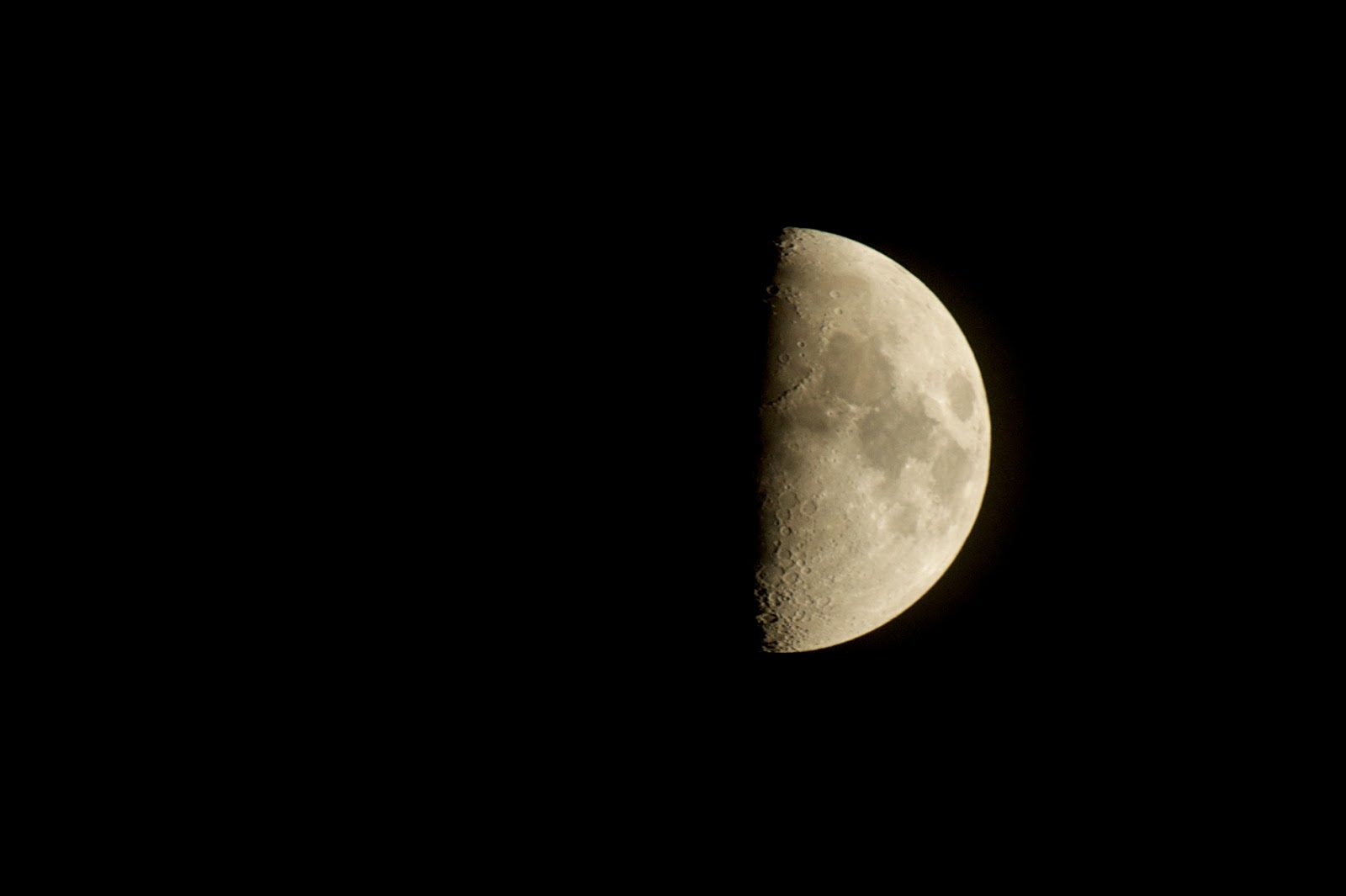
The Full Pink Moon
We’ve had the Wolf Moon (January), Snow Moon (February), Worm Moon (March), and this month, the Pink Moon. According to the Farmer’s Almanac, this name came from the herb moss pink, or wild ground phlox, which is one of the earlier widespread flowers of spring. Other names for this month’s celestial body include the Full Sprouting Grass Moon, the Egg Moon, and among coastal tribes the Full Fish Moon, because this was the time that the shad swam upstream to spawn.
Moon names date back to Native Americans, of what is now the northern and eastern United States. The tribes kept track of the seasons by giving distinctive names to each recurring full Moon. A couple years ago Susan and I had the pleasure of taking a hike, under a full moon, in Bryce Canyon, Utah. The ranger/guide/interpreter told a completely different story about moon names as designated by tribes of that region.
Though the stories were different, the theme was the same: Living one’s life by the phases of moon is much less stressful, or at least has more romantic appeal, than does the artificial calendar we’ve created.
Looking ahead, we have the Flower Moon (May), Strawberry Moon (June), Buck Moon (July), Sturgeon Moon (August), Corn Moon (September), Hunter’s Moon (October), Beaver Moon (November), Cold Moon or Long Nights Moon (December).
But let’s not rush things. Let’s concentrate on flowers and strawberries.
These images were made April 4, a couple days ahead of the actual Full Pink Moon, with some help from our crabapple tree.
Monday, March 26, 2012
California Dreamin’ …
Two Cackling Geese, right, along with a Greater White-fronted Goose
California—that land of opportunity and promise, if not the Promised Land.
Last week, in part to escape the stifling heat of northeast Ohio and in part to visit relatives, Susan and I headed west for some much-needed rest and relaxation. Being retired is not a job for sissies.
And did I mention California held potential for me to find three birds for my life list, catapulting me to the 600 mark for birds seen in North America without a trip to Alaska or on the ocean?
Beautiful Santa Barbara offered much this year—rain, fog, along with temperatures in the forties and fifties for example, the kinds of things we expect in northeast Ohio, not southern California.
But ya gotta love the people out there. Where else would you find a kid skateboarding on a remote, treacherous mountain road so steep and pock-marked that you’re afraid your car won’t make it?
I’m trying to be philosophical about this self-imposed goal to hit 600 life birds by mid April. For example, we went off the second day, having crapped out the first looking for the Cackling Goose, in search of the Varied Thrush, a bird more likely found further north, but reported in a nearby park. After a multi-hour, thorough hunt by three keen-eyed birders, we opted to pack it in at lunch time. At precisely the moment when the camera gear was out of sight, Susan alerted us to a Red-breasted Sapsucker—a bird not even on the radar for this search. ChaaChing! Number 598 in the bag, proving that even when the arrow misses the target it will still hit something. Something like that.
Western Winter Wrens livened the forests
The rest of the week was a grim reminder of how tough finding some birds can be. I thought the Cackling Goose would be a slam dunk. Not so. Nearing the end of our stay we decided to go back to where the Cackling Goose had been reported—on a local golf course, perfect habitat for geese. We scanned a burgeoning flock of Canada Geese and found several Greater White-fronted Geese—good birds but not what we were looking for.
About the time I opening my mouth to say, “Oh well,” Susan said, “Aaaawaitaminute! Look at that white ring at the base of the neck on the smaller birds!”
Sure enough! She found Number 599, eight of them in fact, mixed in with the Canadas. These were the Aleutian race of the Cackling Goose that we do not get here in the eastern parts of the country. Big score. High-fives all ‘round.
White-tailed Kite is always a welcome diversion
Now, with three weeks left, the search continues. Early spring arrivals might be the key. The car has a full tank of gas, camera gear is packed, backpack loaded with a change of underwear in case it’s more than a week-long chase. I’m pumped!
Stay tuned, folks. And thanks for your support.
Subscribe to:
Posts (Atom)