Wednesday, April 20, 2011

Why the Prairie


I checked my not-so-smart cell phone to see how much further I had to go. One small bar still showed, like a nasty smudge, in the upper left corner, telling me I’d gone far, but not far enough. Good. A bit further and what passes for civilization would be a fading image in my rearview mirror.
Kansas, a great place to go when just going is the goal. A place to get off the highway, where you can stand on a rise of land and see beyond your dreams; where the distinctive song of a meadowlark interrupts then overrides the fluttering of flags, where the best view does not have to compete with litter on a stick.
It’s a place where you can stand and look inside yourself when the outside you is not what it used to be.
It’s a place where you ask yourself if you’ve gone the right direction, then realize, it doesn’t matter. The choices you made would put you right where you are—all roads lead to where you stand.
And if you stand at the right spot in Chase County, as I did, listen to history that might be wind in the barbed wire, or maybe music coming from an open barn door, squint your eyes a bit, tilt your head and give free reign to your imagination, ghosts of the past in this western land might come into focus.

How a Slow Birding Day Picks Up Speed


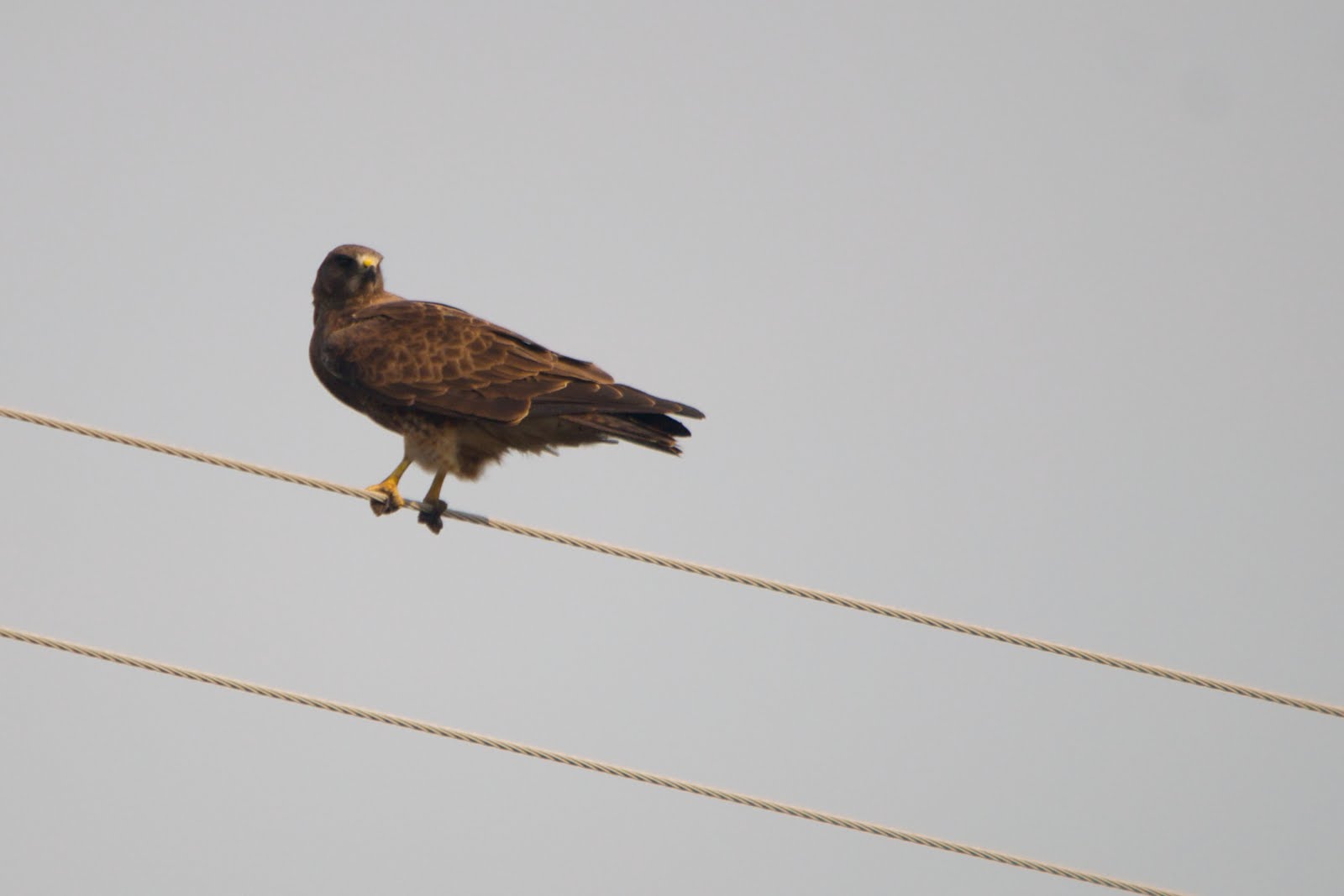
Swainson's Hawk

It had been one of those days that if you judge it by unrealistic goals you set for yourself, would best be described as a flop. I’m currently in Kansas, trying to get some pictures of the spring fires intentionally set to burn off last year’s grass stubble, which renews the soil in the process. Sorry, that’s the layman’s unscientific explanation.
True to form, I’m about a week late. I did see some burning, too far out of camera range, or too small to look like anything more than a trash fire. One of the rangers at the Tall Grass Prairie Preserve in Strong City explained that most burning is finished now because pasturemen have to wait a couple weeks before putting cattle onto burned pasture, and the cattlemen are anxious to get those beefies out there, now.
One thing I did observe is the way various raptors work the burned fields. Makes for easy pickins when rodents have no place to hide.
Late this afternoon I found a wide spot in the road where I could safely wait for a flock of Swainson’s Hawks to work their way over to me. I had never seen so many of this species at one time in one spot. I counted 35 birds all swooping and hover-hunting a burned pasture.
While my attention was focused on the hawks, a flurry of activity passed behind me and landed in the field on the other side of the highway in an unburned area. I could not believe my luck: More than a dozen Upland Sandpipers, a species we rarely get in Ohio, all in alternate plumage.
When I returned to watch the hawks, there one sat on the utility wire, watching me.
As Lance Armstrong says: There are no bad days; some are just better than others.


Upland Sandpipers, east-central Kansas

Friday, April 01, 2011

Ignore Reality, Find Deeper Truth


Wilson's Snipe

It was a dark and stormy night. I well remember my first snipe hunt. I was maybe a dozen years into my first-remembered incarnation, enjoying my first camping adventure as a Boy Scout, filled with the knowledge that I knew everything important enough to matter.
It was our first night in camp. One of the older scouts suggested a snipe hunt. It sounded like fun, dangerous, rewarding—all the things youth looks for in life.
Of course, we had to wait until it got dark. And it gets really dark in the woods. Dark enough to give one second thoughts about crawling around on the ground, armed with stealth, a paper bag and a multi-bladed knife.
The older guys dropped we fearless hunters at various posts around the perimeter of the camp’s parade ground. We were to keep hunting until we heard the “all clear” whistle, then run onto the parade ground with our sack filled with snipes.
The fact that we were never told how one actually captures and subdues these creatures, nor even how large they might be, didn’t seem to occur to us at the time.
If you ever want to know how long forever really is, I suggest you grab a paper bag, head out into the dark of night on your hands and knees, wait and hope for someone to blow a whistle that never happens.
Eventually you figure it out.
In my current incarnation as a birder I’ve learned the truth about snipe, Wilson’s Snipe in particular. While birding in the Big Island Wildlife Management Area (Marion County, Ohio) yesterday, Susan and I happened upon a nice flock of snipe making use of a puddle left behind by Ohio’s recent rains. As I watched them, I figured out the reason we young scouts were unable to catch any on that dark and stormy night more than a half century ago. I think the older guys dropped us in the wrong habitat.


Wilson’s Snipe Big Island Wildlife Management Area

Sunday, March 20, 2011

Shooting the Moon


Even if you’re not addicted to the Weather Channel, don’t have the “What’s Up” app on your iPhone, or consult the Old Farmer’s Almanac before you venture out each day, you no doubt heard or saw some news report that last night was to be a big deal—moon wise.
Since I’m guilty of all of the above, I was more than primed for this closest visit from Luna in the past 19 years. And significantly, she’d not be back this way again for another 19 or 20 years. I did the math and figured I best make a date now, while we were both young enough to enjoy the evening.
She did not disappoint.
After consulting maps, Web sites, even my own memory banks, I opted for the Cuyahoga Valley National Park; the former Richfield Coliseum site in particular. Where once stood a massive sports and entertainment complex now resides prime open field habitat with mostly uncluttered views in all directions.
Armed with my arsenal of photo gear, waiting for Luna to arrive, I was entertained by three Short-eared Owls and more American Woodcocks than I could count. Romance was certainly in the air.


Shortly after 8 p.m. Luna arrived, resplendent in red. What an entrance she made on this evening of perigee, living up to the hyperbole that she would appear 16 percent larger and 30 percent brighter than usual. Truth be told, the difference between 221,565 miles and 250,000 miles is tough for me to discern. Plus, I have to admit I was caught in her grip of moon illusion as she climbed over tree tops on the east rim of the Cuyahoga Valley.
As her colors changed from rubber-ball red to cheddar-cheese orange and eventually shine-on silver, I thought about what life must have been for people who once lived their lives by the phases of the moon, not some human-concocted time warp made crazy twice a year with the misnomer “Daylight Savings Time.”
Saved for what, I asked the darkness.
Luna laughed, too. Daylight is daylight, just as moonlight is moonlight. And it’s all sun light and it’s all right, she said.

Monday, March 14, 2011

Look, Up in the Sky!


Saturday was one of those rare, northeast Ohio March days when the typically gray sky takes on a hue of azure, often referred to as cobalt blue by the weather folks (who don’t understand the meaning of redundancy, either), or gorgeous by the rest of us.
I’ve forgotten what the day’s plans were, however, Susan and I dumped that plan, grabbed our binoculars and headed for an open trail in the Cuyahoga Valley National Park. Recent flooding has cut off a lot of trails, so we opted for one that is away from the river—Horseshoe Pond—a great spot to see Red-breasted Nuthatches, of which we’ve far too few this winter.
Susan’s feet were barely out of the car when she shouted, “Look!” As a proficient birder and trained husband, I did not ask what or where. I could hardly believe my eyes when a Bald Eagle, which must have been perched in a tree near the parking area, took off, huge, graceful, spectacular.


As recent as 1979 the entire state of Ohio had only four nesting pairs of eagles. Now, that number is closer to 200, usually seen from a distance soaring, sometimes perched in a favorite tree near a nest site.
As we scrambled for our binoculars, cameras and breath, two young women started down the trail. As birders are wont to do, we jumped and yelled and pointed for them to look right over their heads to see the eagle. They looked at us like we were from some alien planet, speaking a language and making gestures of which they had no knowledge.
Oh well. Whatever they were listening to on their iPods must have been, well, interesting is a word that comes to mind.
We did not see the Red-breasted Nuthatches we set out to see, however, when you’re close enough to a Bald Eagle to see its red eye, well, all else pales.

Friday, March 11, 2011

Big Surprise


Downy Woodpecker contemplates a snowy treat

One of the better parts of being retired is listening to traffic reports on snowy mornings, designed for those folks who have to get to work—or else. From the warmth of our living room we turn the pages of the local newspaper and listen to classical music until the inevitable question comes up, usually after the most-gnarly traffic jam, “So, should I make some more coffee?”
Most people outside of northeast Ohio don’t know that “Cuyahoga,” the name of our major river, in Native American speak, really means, “parking lot.”
So you get days, like today, when we haven’t had snow for three or four days and people suspend the rules of sanity, drive like it was August, and generally assume the attitudes of extras from the movie, “One Flew Over the Cuckoo’s Nest.”
Makes for great traffic reports.
Meanwhile, the local bird population (too early for cuckoos) take it all in stride—or flap as it were. Four more inches of the white stuff does not seem to faze them.
I did notice our resident Cooper’s Hawk is wearing his “Ya Gotta B Tough to Live in Cleveland” T-shirt this morning.

Tuesday, March 01, 2011

Expect the Unexpected


Cedar Waxwing

The admonition, “expect the unexpected,” works well whether you’re fishing, fighting a war or birding. It even provides a fairly good guideline for blind dates.
Birders seem to take it as a matter of course that when you set out to see one thing, you're often rewarded with something else, maybe something you don’t expect. Unless, and it’s a big unless, you’re carrying a camera. Then, there’s a strange, inverse, unwritten, little-understood rule that applies: The bigger the camera you’re carrying, the less likely you are to see whatever it is you set out to see. Something like that.
So it was this afternoon when I set out, loaded with camera gear, to get some pix of newly arrived Red-winged Blackbirds. I really enjoy these noisey little guys, sharp black suits with red and yellow epaulets, constantly advertising for a mate, defending the nest territory against any and every thing. It’s strange how, in the fall, you never see these birds depart. One day they’re out there in the wetlands squawking up a storm, the next they’re gone.


Eastern Bluebird

Similarly, in the spring, one day it’s quiet along your usual walk, the next there’s a racket that can only mean one thing, the boys are back in town—and welcome back fellers, there’s a lot of quiet space out here that needs to be filled.
Saturday there was not a Red-winged Blackbird to be seen, Sunday they were all over the place and I did not have a camera. I planned to get some pix on Monday, but then the sky opened and the Cuyahoga River jumped its banks by a whopping 22.7 feet, second highest flood stage since someone started keeping records.
So today was the day, bright, sunny, crisp, some high cirrus clouds, light winds. A day filled with promise. As I started down the bike/hike trail near my house I realized something was missing. Not a blackbird to be heard. I thought I detected one calling way off. A half mile into my walk and still not a peep, or aarrraaakkkkk, as it were. Things were not going according to my plan.
A mile into the walk I was having serious second and third thoughts about getting those blackbird pictures. I heard some rustling and high-pitched squabbling in the bushes behind me. I turned to see what all the chatter was and faced an estimated 50 Cedar Waxwings, eye level, paying no attention me.
Five minutes later a took my first breath. Whew! What a rush. Then Eastern Bluebirds got off the bird bus and flew into the bushes now vacated by the waxwings. There were not as many bluebirds, however, a little bit of that azure color goes a long way in the drab days of early March.
I turned at my 1.5 mile spot and headed for home, thoroughly satisfied, even without the Red-winged Blackbird photo I came for. Aarrraaakkkkk, right on cue he arrived. One bird. But one was all I needed.


Red-winged Blackbird

Wednesday, February 23, 2011

Spring’s True Harbinger


Northern Cardinal, leader of the spring chorus, and fanciest dresser

I was out walking early this morning, well, relatively early, about 8 a.m., when I noticed one of those spring harbingers. It was not one many people talk about. Forget about that first-robin-of spring myth. American Robins can be found year round in northeast Ohio.
No, for birders, I think the first indication, the promise that we will not freeze to death or run out of food before winter’s end, is the dawn chorus; that glorious sound of birds competing to see who has the loudest, best song among their own kind and among all the other singers. The chorus lasts not long enough.


American Goldfinch preparing his spring outfit

It can bring about one of those whacky challenges when you’re camping, before the sun has made it’s decision to brighten the day, birds start singing and you and your tent mate try to name as many species as possible. Sometimes it’s that incessant cardinal perched on the railing outside your bedroom window at 4 a.m., unsure if he’s getting home late or getting up early, who wants to be sure everyone else in the world is there to celebrate the crack of dawn with him.
Hey, we’re retired. We know how to find fun, wherever.
This morning I stopped in my tracks, single-digit temperatures aside, to listen to the dawn chorus, an unfamiliar sound from familiar birds. It was all the usual suspects, cardinals, chickadees, robins and titmice. The song they sang, “It Won’t Be Long Now,” is one of my most favorites.


Carolina Wren, a welcome, unfamiliar voice in the dawn chorus

Wednesday, February 16, 2011

Snow by Any Definition


Western Snowy Plover


Snowy does not always mean what you think. California, a land of contrasts if there ever was one, plays host to two highly endangered birds: the huge California Condor and the tiny Western Snowy Plover.
With a name like Snowy, you’d suspect the bird had some connection to lands farther north than California, especially the beaches of California. Not so. Linnaeus named this small bird (Charadrius alexandrinus) in 1758 (Syst. Nat. 10(1):150) for its presence in Alexandria, Egypt. It’s found, in small numbers, worldwide. I suppose it got the snowy part of its name from its ghost-like color.
The Pacific Coast population of the Western Snowy Plover is federally listed under the Endangered Species Act of 1973 as threatened. The Western Snowy Plover is a Bird Species of Special Concern in California. Snowy plovers were listed as endangered under Washington’s (state) Department of Game Policy, and as threatened by the Oregon Fish and Wildlife Commission. A lot of folks are concerned about this tiny bird, only the size of a fat sparrow.
Plovers will use almost anything they can find on the beach to make their nests, including kelp, driftwood, shells, rocks, and even human footprints.


Footprints make a great spot to rest

Although it was not nesting season while Susan and I were recently in California, we visited a protected area near Isla Vista where we had found the bird in the past. Sure enough, a few birds were hanging out, eating bugs, doing all those plover things, paying little attention to us humans.
Unfortunately, that could be the birds’ downfall. It tolerates us, and other creatures, to the point of its own demise. It nests in piles of dead kelp, even human footprints. It’s easy pickins for dogs, and many other introduced predators. When disturbed enough they will run away, leaving the nest and eggs vulnerable.
I sat and watched the birds for a while to see what they do, since surfing, texting and television do not seem to be part of their game plan. It seems what the do best, or most, is watch. They watched me watching them. They watch the tides and the foaming waves. They seem to like to stand and feel the wind and its direction, then turn accordingly so their feathers can ruffle. They watch each other for companionship and to initiate a chase for no reason I could determine. They particularly watch human activity. They watch people walk past. They watch dogs on leash and off leash, it doesn't make a bit of difference to them.
The longer I watched the more I realized I was getting a life lesson here and I better pay attention.


Feeling the wind, checking the footprints, another busy day for a Western Snowy Plover

Saturday, February 12, 2011

Looking Forward to the Past


The La Huerta Project at the Mission of Santa Barbara, California

While Susan and I were in California recently, recharging our solar-powered batteries, we paid a visit to an interesting gardening project she read about. It’s called the La Huetra Project at the mission in Santa Barbara.

Upon arrival at the mission, our first challenge was finding a way into the garden area. Had it been left to me we’d still be wandering around the parking lot looking for the gate. Susan wisely asked directions of the first person she saw. Turns out she asked the right guy. It just happened to be Jerry Sortomme, professor emeritus of the Santa Barbara City College Environmental Horticulture program. He’s been the spearhead of this project to locate and propagate plants for a new mission garden since 2003. The original idea-seeds for this project were sewn in 1999.

We could not have asked for a better, more genial host or more-informed guide. Jerry not only gave us a history lesson in gardening, I think during the more than two hours we spent with him, he brought us up speed on everything that’s happened along the California coast since 1769.

The heart and soul—you might say the mission—of the mission project is to recreate the huerta, or garden, (some Spanish translations of this word say it is like a door or entrance way) where friars cultivated food and other usable crops required for their daily life in the early 1800s. Jerry said the garden has, and will have, no plants that arrived in California after 1834, about the time when the Mexican government, which achieved independence in 1822, took a hard look at what was known as Alta California and decided to secularize the missions.

Jerry and his team of volunteers do a lot of spade work even before the digging starts outside. They research long lists of plants grown during the mission era, delving into the writings of church officials as well as early visitors and residents. The array of non-native and native plants grown on mission property is long and interesting. Some records go back as early as 1769. Of special interest to Jerry are heritage plants. These are species that represent living material, obtained from unaltered plants documented to be from a particular place and time. He uses modern DNA testing to verify cuttings, like that of a 100-year-old grapevine to assure that it is the authentic ‘Mission’ grape.

Through the dedicated efforts of volunteers, this project will keep alive a part of history rapidly being lost not only in California, but all over the planet as we—for better or worse—alter the structure of plants. So, if you’re in the area of Santa Barbara and you want to see what life, garden life, was like before 1834, stop in at the mission’s La Huerta garden. And, if you can’t suppress the urge to get your hands dirty, pull a few weeds, or dead-head flowers, visit on a Wednesday morning. Jerry can always use another volunteer.


Jerry Sortamme, who has headed the La Huerta Project for nearly a decade, answered all Susan's questions--and more

Thursday, February 10, 2011

Feeding in February


Downy Woodpeckers on a lunch date


This morning I was reminded that February is Bird Feeder Month for those of us in the birding world. It’s time to pay a bit more attention to our feathered friends, I suppose because we’re often snowed in and can’t do anything else but sit at the window and dream of sunny days to come.
Around our place we long ago realized that by adding a water element, i.e. a bird bath, to our array of feeders, we attract more than our share of birds and other critters. Along with birds we get most of the squirrels in northern Summit County, as well as, per tracks in the snow, the occasional White-tailed deer.
It’s the birds, however, that provide the most entertainment. Often American Robins, four or five at a time, line the edge of the bird bath (heated in this weather, of course) and drink in unison, picking up beaks full of water, then tipping their heads back like a chorus of gospel singers to drink. Fascinating are the Mourning Doves, one of the few species of birds that can swallow, thus dipping their heads in to their eyeballs to suck up their drinks.
Most impressive is the politeness of it all. It’s not uncommon to see a half dozen species of birds sitting in the branches waiting their turns at the water. I think our politicians could learn a lesson in deportment here: Wait your turn at the public trough, there’s plenty for everyone.
This Winter we’ve had our quota of the usual feeder suspects, plus the occasional Pine Siskin along with a single Common Redpoll who put in a cameo appearance a few weeks ago.
So, if you’re thinking about feeding birds during these harsh winter months (you can do it year round and enjoy the antics youngsters in the Spring), consider adding a heated bird bath. It will increase your enjoyment and add, measurably, to the birds’ ability to survive.


American Robins with an invited European Starling guest

Thursday, February 03, 2011

Two Questions, Maybe Three


Red-tailed Hawk

I’ve been fortunate to bird in California for the past 10 days or so, long enough to get that California-mellow feeling about most things in life. So, this morning, birding a spot I had not visited for several years because of fire damage, I was Mr. Mellow, more or less ready for anything. I was hit with a couple questions, questions I seem to hear wherever I bird, questions I was able to answer in a laid-back manner, not the usual smart-ass replies I prefer to give. When it was all over, I thought about the questions and tried to find some common denominator.
Question one, from two women walking what I suppose were dogs.
Them: (All eyes, smiles and excitement.) Seen any good birds, yet?
Me: (Thinking all birds are good. And what’s a good, or bad, bird? And ‘yet’ implies that I will.) Oh yeah, but then, I’m from Cleveland so …
Them: (Mumbling something about Cleveland.) Great weather. What didja see?
Me: (Always ready to educate.) Well, there’s a nice Spotted Towhee just ahead of you, and Lesser Goldfinches seem to be everywhere.
Them: (Already disengaged.) Well, have a nice day!
Me: (Somewhat baffled.) Ah, thanks.
The second question of the morning was one our birding buddy, Pat Coy, absolutely loves, looks forward to, stays up at night in anticipation of.
Man walking his dog: (Making a statement, not asking a question.) So, you’re a bird watcher?
Me: (Being mellow.) Yup.
Him: (Authoritatively.) So, ya seen any eagles, yet.
Me: (Trying my damndest to repress a laugh.) Well, no. Don’t really expect to. It’d be nice, of course, but …
Him: (Not letting me finish.) Hell’s bells, they’re all over the place. Look right over there.
Me: (Always ready to educate.) Ah, that’s a Red-tailed Hawk.
Him: (Turning to leave in a huff.) Bullshit.
Me: (Being mellow.) Ah, have a nice day.
The third question was similar to the first two, really more of a statement than a question. Three well-dressed (for walking) ladies with one white dog smaller than most cats I’ve seen.
Lady with the bluest hair: (Eyes on all my cameras, binoculars, etc.) Are you looking for birds?
Me: (Asking the higher powers not to say, ‘No, fish, actually.) Yup.
Lady #2: (Trying not to have her kneecaps sliced by the frigging dog that kept yapping and running around.) Do you need all that stuff?
Me: (Suddenly feeling the various straps cut into my flesh.) Well, I take a lot of pictures and …
Lady #1: (Trying to skip rope with the dog leash.) Why don’t you just look them up in the internets? That’s easier. Besides, where are they?
Me: (Blinded by this flash of the obvious.) Ah, well, ah, all you have to do is look up …
The trio: (Satisfied they had given me necessary advice to succeed in life.) You just have a nice day, young man.
I had to sit on the nearest log, totally exhausted, and think about this last hour of conversations. These people were all out walking in a county park, so how could they be so oblivious to their surroundings?
That was when I remembered something a botanist told us yesterday, “There are a lot of people suffering from NDD around here.”
I had to ask what NDD was, and prepared to stop at the local pharmacy to get some protection.
“It’s Nature Deficit Disorder,” he said.


Lesser Goldfinch

Saturday, January 01, 2011

Breakfast Banter


I was having breakfast, so was he, each on his chosen side of the glass. He watched as I spooned in oatmeal, coffee, juice, toast, the whole deal.
I tried not to feel guilty. The feeders had been filled the day before so there was no shortage of dusty, dry sunflower seeds and ice-cold water.


When he was sure I had finished, he began to examine the branch he had perched upon. He thoroughly inspected each new bud, then, finding one to his liking, assaulted it with vigor.


What better way to take on the new year than with a full belly.

Friday, December 31, 2010

End of the Year


Northern Shovelers, Castalia, Ohio

It’s not uncommon at this time of year for birders to take a look at their life list and contemplate adding one more bird, or maybe chasing after a rare sighting in the area to sort of pump up the yearly species total. This past week I found myself guilty on both counts. The end result can be both good and less than good.
First, I thought Santa was going to deliver an early Christmas present to me. A few days before the holiday word popped up on the Ohio Ornithological Society’s hot line that several Ross’s Geese were at Castalia Pond, about 75 miles away, along with several Cackling Geese. The alarm bells sounded in our household and it wasn’t the jingling of sleigh bells. While both Susan and I have tallied the Ross’s Goose, the Cackling variety of Canada Goose has eluded us.
Plans were made, snacks packed, car gassed up and off we went. Oh, we did have company for the holidays, my brother in from the nation’s capital. He had heard of this bird-chasing habit of ours but had never witnessed it. I might add that he hates cold weather and the day’s temperature was 18—not a good combination.


American Wigeon, Castalia, Ohio

The end of the story is that it turned out to be a wild goose chase. The “target” birds were nowhere to be seen. My brother could not understand why we were not dismayed at driving all that distance and not seeing the bird. I tried to explain it’s an acquired skill, missing the target but hitting something else, like stunning Northern Shovelers and American Wigeons.
Then, on New Year’s Eve day, we had a repeat performance, sort of. This time it was a Golden Eagle reported at Mosquito Creek Wildlife Area, about 75 miles in the opposite direction. Again, we’ve both tallied the golden, but it’s so rare in Ohio, you just have to chase it—if at all possible. Our first in Ohio, several years ago, was on a day when the thermometer never got above minus 13. Now, that’s chilly—but worth it.
Again, to shorten the story, the beautiful Golden Eagle was not to be seen. In its place we tallied six Bald Eagles, an equally rare sight in Ohio.
All of which goes to prove, sometimes you win and sometimes you win in the birding game—true sport has no losers.


Bald Eagle, Mosquito Creek Wildlife Area

Thursday, December 02, 2010

Not Just Another Sparrow—Part 2


Eurasian Tree Sparrow

For many birders, making a trip to St. Louis was, and still is, akin to a trip to any spot of birding where a rarity can be found. It was, is, the only place in the U.S. where you could tick the Eurasian Tree Sparrow off your life list.
A lot of mysteries surround this diminutive bird, the greatest for me is why the bird does not expand beyond its current range. Twenty-five years ago there was an article in the American Birding Association’s newsletter about the sparrow and how to locate it—within a well-defined neighborhood in St. Louis. Over the years the article has helped a lot of birders track down this little guy.
Now, it seems the bird is expanding its range from the three-block area where it has thrived. We’ve seen it across the Mississippi River in the Riverlands Project area and, fortunately, in the suburbs—right at my mother-in-law’s feeder on occasion. Today was such an occasion.
How the bird got to St Louis is not a mystery. In the 19th century, south St. Louis was the home of many European immigrants who wanted to see familiar birds from their homeland. So, on April 25, 1870, 12 Eurasian Tree Sparrows were released in Lafayette Park in south St. Louis. Numbers of other European birds were also released (European Goldfinches, Eurasian Bullfinches, Chaffinches, Greenfinches, and Linnets), but only the Eurasian Tree Sparrow successfully established a breeding population.
The birds are not physically remarkable, only rare—which makes it remarkable, I guess. It’s still somewhat secretive out here in the ‘burbs, so any sighting is worth recording. As luck would have it, the trio I saw this morning was cavorting with some House Sparrows allowing for great size and color comparisons.
I suppose purists complain about these essentially invasive species, however, the diversity crowd seems to have assured the continuation of these critters, based on the notion that a life bird is a life bird.

Wednesday, December 01, 2010

Hunting for Ghosts


Woodson County courthouse, Yates Center, Kansas.

I stood looking at the imposing red brick courthouse, probably, possibly, where my father stood nearly 95 years ago during the Kansas-life he had, and I never knew about. He was a kid fresh into his teens in 1916, anchored by so many loose ends in his life we can’t begin to imagine—or long for. The building stands in the near-geographic center of Woodson County, Kansas, where my genealogy research has most recently taken me.
Looking east, the direction from which he had somehow managed to navigate, colorful buildings built in the late 1880s, restored numerous times, blocked my view of the rising sun. Looking west, were his future with disappointments he’d yet to discover, lay, dark clouds and unrelenting winds welcomed me to late-November Kansas.
The streets are, were, uneven, made of solid, unspeaking bricks, darker in color than those used to build the courthouse building, designed to keep secrets intact. No stop signs around this square to impede traffic or progress, one might guess. Angle parking on both sides of the street still left plenty of room for modern cars to make U-turns. I closed my eyes and tried to imagine what might have been when the dirt streets were crowded when long-horned cattle passing through from the no-longer existing railroads to the tall grass prairies north and west of Yates Center.
My camouflage, head to toe, seemed a bit off the mark—again. First, my car was the only one of its kind in this land of seriously big pickup trucks and SUVs I'd need a step ladder to get into. I’m no slave to fashion, so when I entered the Feedbunk, the only place around to get breakfast, I donned the obligatory baseball cap, however, mine advertised striped bass, not some cattle feed or farm implement. I had on my best Justin boots, only to learn natives dress in real camo and wear Nike and New Balance. Since I was relatively free of mud at 6:30 a.m., they probably sensed I was an outsider. (Full disclosure: I’m something of a city guy so I had to ask what a “Feedbunk” was. The waitress looked at me like I might be from outer space and said, “Well, honey, it’s where we put the feed for the cattle,” which I guess is better than calling your restaurant the Food Trough.
I ate at the Foodbunk two mornings, noting that the same guys sat in the same spots, wearing the same clothes both mornings. The things that changed were the conversations, which extended from one table across the aisle to another, booth to booth. I noticed the waitress never offered the locals a menu. She’d just ask, “Are ya eatin’ this morning?” then bring a customer a plate of food.
Conversations ranged from lost dogs, “Yer dog ever come home, Bill?” “Yep. Never did tell me where he’d been for three days,” to hunting; “Yer nephews get any birds yesterday?” “Those two fools? First the young one shot up a trash bag that was blowin’ across the field, then the otherun shot two crows, then they complained ‘bout not seein’ any pheasants.”
I’m not sure if the conversations were real or just for my entertainment. Doesn’t matter, really. As writer William Least Heat-Moon says, “You can worry about every twist in the road, or you can sit back and enjoy the scenery.”


Where my dad’s dreams of being a cowboy began 95 years ago.

Saturday, November 27, 2010

When Size Doesn’t Matter


When it comes to singing, the tiny Carolina Wren can yodel with the best of them. This diminutive bird, about 20 grams soaking wet, 17 centimeters long, might not be the largest of wrens, however, when it comes to singing, it’s in a class by itself. Its song is said to be one of the louder per volume of bird. One male was know to sing about 3,000 times per day. Songs of these birds can vary regionally and contrary to the way humans speak, birds of the north tend to sing slower than birds of the south.
Winter weather takes its toll on this species in northeast Ohio where I live. Visiting with my mother-in-law in St. Louis is always a treat if we haven’t had a large enough Carolina Wren fix back home. I recently read that climate change might in fact help this species to move and stay in more northern climates as things warm—globally.
The Carolina Wren is primarily a southeastern species so seeing them as far west as St. Louis is pushing the limits of their range.
Another unique thing about this species is that pairs will bond for life, often staying together on their territory year round.
Although the birds are primarily insect eaters, you can lure them in with seed, as I did. If you’re out in the woods and you hear a song that sounds like teakettle-teakettle-teakettle, or, like someone running their thumb along the teeth of a comb, it’s probably a Carolina Wren. Stop, look and listen.

Tuesday, November 23, 2010

Stalking Wildlife


Fox Sparrow, St. Louis, Missouri

My heart was pounding. The quarry was a Fox Sparrow, not uncommon, however, uncommon enough for us that we tick off only one or two per season. As sparrows go, this one is right near the top in good looks. Its feeding habits, much like a towhee, don’t make getting these guys on film (a photo term from the last century) easy. They hang out in deep brush, scratching among leafs like they hadn’t eaten in a couple weeks.
This one, however, opted to hunt closer to me than I could believe. I was ensconced in a comfy chair with a good book, wearing my best camo outfit, jeans and brown chamois shirt as he approached. I was completely hidden behind a blind of glass, unsure of where my camera was. Well, maybe the camo and the blind were not the best, I should have been better prepared.
I dropped to the floor and worked my way behind the chairs, then sat still, watching the bird snagging bug after bug in the leaf litter. Well, hardly was I still. I was burning up electrons like they were free—which they are. I wondered if he could hear the camera’s motor. Suddenly he seemed interested in what I was doing behind the glass blind. He moved closer and closer, stalking me.
At the point we both became cross-eyed, he went back to his bugs and I took my first breath in about two minutes.


Fox Sparrow, St. Louis, Missouri

Sunday, November 21, 2010

Learning Something New


Every now and then, as in once-in-a-blue-moon, I learn something I thought I already knew. I was having a sort of routine chat online with fishing buddy Tom when for no apparent reason he brings up the fact that tonight, November 21, is a blue moon. I didn’t know if he wanted to get together and howl a bit, or what?
I realized, too late, he had trapped me since I like to think I know most of this kinda nature stuff and he tends to be the willing student—well listener at least. Fishing is another matter.
No way is this a blue moon month, says me. Ya haveta have two full moons in the same month for it to be a blue moon. Not so, says he.
Former editor that I am I immediately asked him about his sources.
Dang if he isn’t right. The presumption I’ve lived with for eons has been wrong! We can blame a lot of the confusion on those Gregorian monks’ party planner and their calendars, which did not quite sync with the moon’s cycle of 29.5 days. Those dudes planned all kinds of feasts, planting and who knows what else around the moon’s cycle, usually on the last full moon of the season.
So, to bring a little chaos to the orderly pattern of the moon, the monks opted to make the third full moon in any season, the blue moon. When an extra full moon happened in a season (and screwed up the party plan) they called it a blue moon—an unusual event. By doing so, they could stick with the established name of the last full moon in a season—The Last Full Moon of the Season.
Well, this full moon in November is the only blue moon of the year 2010, reason enough to celebrate. I stepped outside a few minutes ago to explain all this to Luna, who really didn’t care. She lectured me about the loony confusions of man—like calendars. “Live your life by the cycles of the moon. Forget numbers. This is the full beaver moon, last month it was the hunter’s moon, and when next you see me it will be the full wolf moon. Wrap yourself in some cold sheets and dream. I’ll be on my way, now.”

Friday, November 19, 2010

Once More, With Feeling


Clouds and trees offer an artistic challenge to astrobirding.

The caller didn’t identify himself, which made me feel like I’d walked into the middle of a conversation. It went something like this:
Ring, ring.
Me: Hello
Him: You wrote about it a couple years ago and now I got a telescope and I want to try it.
Me: Aaaaaa, I’m not sure …
Him: You know, looking at birds through the scope with the moon in the background.
Me: Oh, yeah, right. I called it astrobirding and …
Him: That’s it. So how do I do it?
I’ll spare you the rest of the conversation. I tend to get calls and email like this when there’s a full moon. I looked out the window and, sure enough, a full moon was rising in the east. In spite of the low-40s temperature I went out to see what I could see.
So for the caller, and anyone else who needs a refresher of that November 3, 2009 blog, here’s a re-write.
Birding in winter months is either tough in the extremis, or boring to tears. Our part of the world here in northeast Ohio offers little middle ground. Watching House Finches at the feeder every day is not exactly challenging. Feeling tears freeze to your face while standing on the shores of Lake Erie looking for gulls is more challenge than many people want.
Well, here’s a dimension to birding I suspect you’ve not tried. It offers an opportunity to see things you’ve not seen before. Or, more accurately, to see them in a different light. I call it astrobirding. Here’s how it works.
It so happens that winter months offer excellent opportunities for astrobirding. On nights with a full moon, such as last night, or near-full moon, haul out your spotting scope. Focus on the nearest astronomical object we have—the moon. If you have an eyepiece that gives you 30X magnification you’ll see sights you might not expect. It also works with binoculars, however, it’s not as exciting since you can’t get the high magnification.
Although looking at the moon before and after the midpoint of its near-monthly trip through the sky yields more exciting moon views, it’s when the moon is full that you have the best chance of spotting birds.
Actually, the moon’s not really full. It’s a half moon since we can’t see the backside, but that’s another story.
This time of the year, with clear, stable air, is ideal for astrobirding. Birds in the night sky drift overhead. Our nearest celestial neighbor makes the perfect backdrop. The next couple months provide us with some great opportunities. You’ll have about seven hours of full-moon time to stare through your scope and watch for owls, swans, cranes, flights of ducks and whatever else might be slashing through the late-fall night sky.
Check an almanac, your local paper or www.weather.com for moon rise and set times. The next three months will be great because the moon rises in the late afternoon or early evening, perfect timing.
Birds crossing the face of the moon move fast, or so it seems. They appear more as impressions than actual sightings. When you see something, back away from the eyepiece, reflect on what you saw—or thought you saw—and take an educated guess.
Silhouettes: fleeting as memories; elusive as dreams.
Any night, two or three nights on either side of the full moon work for astrobirding. In November we hit the full moon on the 20th. In December it’s the 21st.
I keep watching and hoping for a loon to cross the face of luna.


Last night’s full moon

Thursday, November 11, 2010

Death as a Destination


Fatso getting ready for a long winter's nap.

For some animals, humans in particular, sleep is like a temporary death. It’s one way to get through the long night, albeit, haunting, mesmerizing, sometimes undisturbed. For chipmunks, getting through the night is about as close to death as one can be and still think about a future.
At this time of year we still see the furry creatures scurrying about, gathering seeds, cheeks stuffed to beyond belief with that meal they hope will come in seven or eight months. Proper planning prevents piss-poor performance as my hiking buddy, Tom, often says.
Some place along the evolutionary continuum, chipmunks faced the decision: Migrate, adapt or hibernate.
I can imagine the scene, representatives of all 24 species of these furry critters are seated around a table having coffee and sunflower seeds. “Let’s migrate, guys, just like the birds and Wildebeests,” says their democratically elected leader.
“Can’t, Fred, our legs are too short,” comes a shout from the far end of the table.
“Okay then, let’s make peace, not war, and adapt to this cold, white stuff,” comes a cheery suggestion.
“Can’t Cindy, we have hair and you need fur to withstand that cold stuff. Plus, all our food is buried,” says Charlie.
“Okay, why don’t we just snuggle in and take a nap. A nice, long nap,” says the voice of reason.
“Hmmm, that sounds like a good plan, Susie. Let’s go for it!”
The meeting ends and everyone evolves happily ever after.
These random thoughts came to me as I watched one of our local chipmunks (we’ve named him Fatso) clean out the bird feeders this morning. He’s putting on the fat that will carry him through. According to online sources, chipmunks, also called ground squirrels, normally have a body temperature of 37°C. Getting through the winter requires he double his body mass.
During the winter his heart beat drops from 350 beats per minute to 4 beats per minute. (How ‘bout that, Lance Armstrong!) Also, Fatso’s body temperature will drop from 37°C, to an incredible 3°C.
As one might expect, all of his body processes slow so less fat will be consumed. In Spring, little Fatso will wake weighing about 160 grams, down from the plump 300 grams he started with in December. Unlike humans of a certain age, he will wake only every couple weeks to urinate. (No, I don’t know where. I assume he has a toilet someplace in his underground nest.)
Scientists estimate about two-thirds of the chipmunks never see the light of a spring morning. They die because their bodies run out of food reserves or some predator such as a fox finds them while they are asleep.
Other than that two-third dying part, it sounds like the Chipmunk Strategy has some merit.


Drink all you want when you only have to pee every two weeks.

Sunday, November 07, 2010

Easy Come, Easy Go


It was the first snowfall of the season and it won’t be the last snowfall of the season. It was the snowfall all children long for, greet with words like “Oooohh mannnnnn,” imagine three-segment people with top hats, days without teachers. It was the kind of snowfall adults of a certain age anticipate with dread, conjuring moments of stark terror in an automobile, late or missed appointments, scuttled hope-filled dates.
It was the snowfall we all know will arrive, yet never seem prepared for, clothed for, provisioned for, or desired for.
It was the snowfall, that for adults of a certain age, generates images of simpler times, deeper snows, visions of three-segment people in the yard, and words like, “Oooooh mannnnn.”
It was the first snowfall of the season, the one that on the next day reminds us and leaves us with the unanswered question: When the snow melts, where does the white color go?