Friday, June 22, 2012

Moon in June


                             Two-day-old moon

Clouds come from time to time—
and bring to men a chance to rest

from looking at the moon.

Matsuo Basho

Tuesday, June 05, 2012

See Ya Next Time Around, Maybe Not


Transit of Venus begins, June 5, 2012

This evening was the Transit of Venus; an astronomical event that takes place rarely. The last time was in 2004 when no one living had seen the planet Venus come between Earth and Sun. Today, eight years later, Venus again passed between Earth and Sun. Next time will be in 2117, so, if you missed it, well …
Susan and I joined several hundred other astronomy enthusiasts at the brand spanking new 1100 acre, Observatory Park, part of the Geauga County Park System. The park will officially open June 16, however, today’s Transit of Venus event really opened the eyes of hundreds of people, especially those who thought astronomy was something that happens in the dark of night.
I was too busy tending my scope and talking with people to count the others doing the same, however, I’d guess there were at least 30 scopes available for people to witness this event. No one alive today—except maybe the babies in arms with some help from medical science—will see this phenomena again.


Transit of Venus across the Sun lasted until sundown at our latitude

Johannes Kepler, in 1627, is given credit for figuring out the whole transit thing on paper and called the shot for it to happen in 1639. The technology for actual viewing did not come along for many years. The transit of 1761 was the first viewed by a team of scientists around the world.
The day here was cloudy, threatening rain right up to the time we had to head for the park. We wisely made the decision to go for it and hope the sky would clear. We got lucky. Just as we got to the park the sky started to clear and although clouds did make the pictures a bit fuzzy, watching something happen 93 million miles away is too cool to let a few clouds get in the way. Venus is 67 million miles from the Sun so on those rare occasions its orbit comes between Earth and Sun.


In the land of the blind, the one-eyed man is king. Here, I get to dazzle four-year-old kids with my knowledge. (Photo by Susan Jones)


This was the Transit of Venus, June 2004, shot at sunrise from Marblehead, Ohio

Monday, June 04, 2012

Lost And Found


Sandhill Cranes at Killbuck Marsh Wildlife Area

Page two. A couple days ago I wrote about our great field trip last Saturday to the Killbuck Marsh Wildlife Area near Shreve, Ohio. Well, here’s the rest of the story.
On Sunday Susan discovered she had misplaced her new-favorite cap. It took a little brain work (I was well qualified) to determine that the hat was still down at the offices of the Area Wilderness Headquarters. A call to Tom Henry started the recovery process, with final confirmation early Monday morning. Being retired and having nothing better to do than bird one of the premier spots in Ohio, we were loaded and on the road by the crack of 8:30 am Monday.
And a gorgeous morning for a drive it was. Mike and others were at the office, hat in hand. After some great conversation with Eric about the Killbuck Marsh and its future, we thought a little birding was in order. And if we stalled around long enough we’d be just about on schedule for lunch at the Amish restaurant in Shreve.


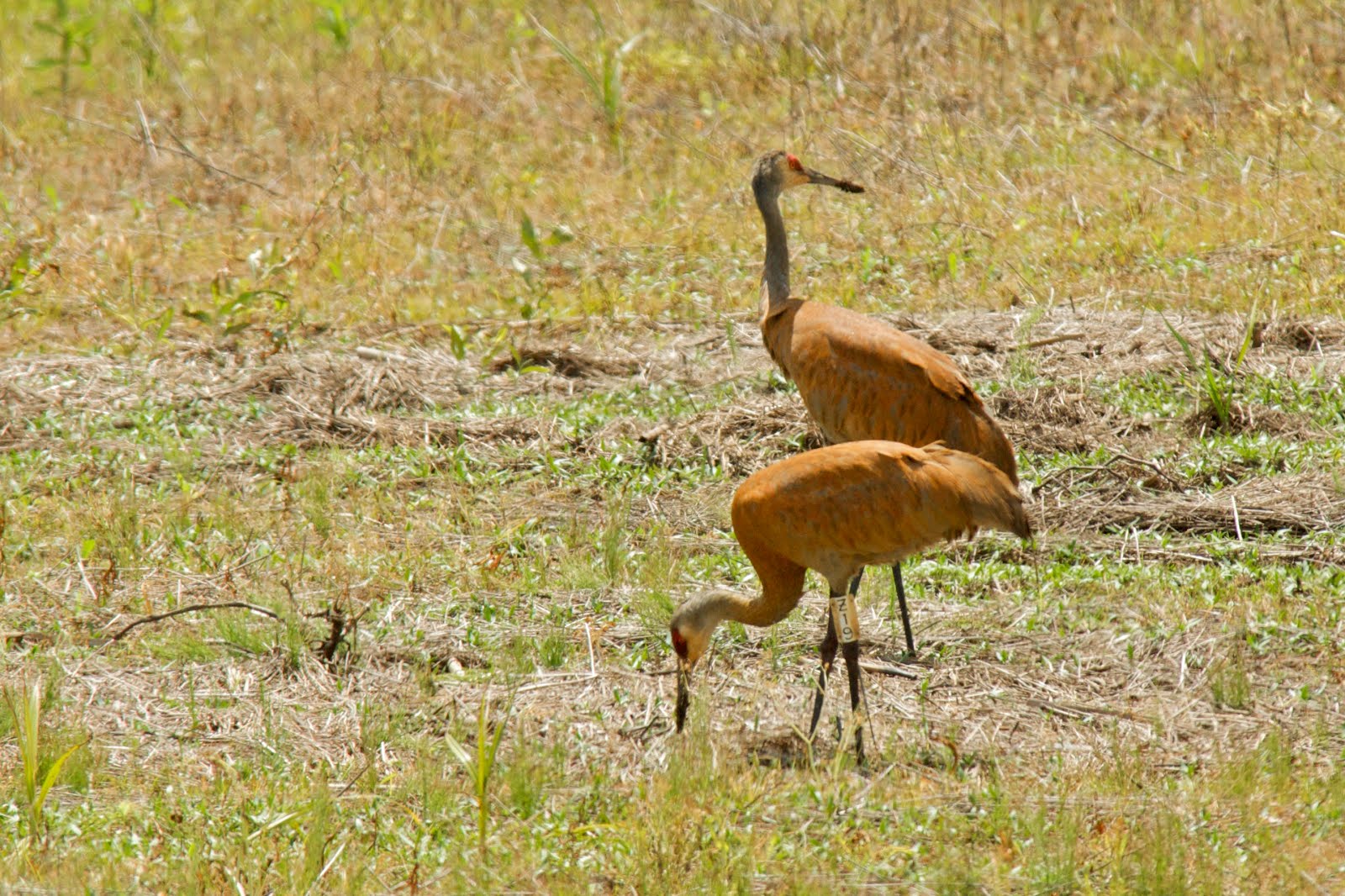
This pair of cranes was among the flock of 30 we saw

We returned to some of the spots Su Snyder had introduced us to on Saturday, then decided to take a quick look from the observation platform overlooking the marsh in hopes of seeing some Sandhill Cranes. On Saturday we saw a half dozen or so. Eric said the flock numbers about 50.
Our reward for searching a bit harder was drop-dead, in-your-face looks at a pair of cranes. One bird was close enough to read the band on its leg: Z-19. From the observation platform we counted 28 more of these special birds in breeding plumage, a rare finding in this neck of the woods.


Tonight, June 4, is the Full Strawberry Moon, named for the time of year. I suppose there's a reason they did not name it the Rhubard Moon. Anyway, this is how it appeared last night through the trees in our yard.

Sunday, June 03, 2012

Owls Take Center Stage


Five-week-old Barn Owl Chick

Have you ever attended one of those concerts where the opening act almost steals the show from the headliner? So it was Saturday when Susan and I, along with about two dozen birders from The Wilderness Center Bird Club of Wilmot and the Kirtland Bird Club of Cleveland, had the opportunity to watch the banding of Barn Owls at Killbuck Marsh Wildlife Area. Barn Owls were the headline act, however, Cliff Swallows at the farm of Perry Yoder set the tone for the day—and it was a tough act to follow.
Through the Herculean efforts of Su Snyder of TWC and Eileen Zimlich of KBC, we saw the show of a lifetime. It started with some early morning birding of areas around Killbuck that Su knows so well and reports on so diligently. Mid-morning we stopped at the immaculate farm of Perry Yoder to see nesting Cliff Swallows. I expected the usual half dozen or so birds flying around. Whoa! This Amish farmer and his family have been encouraging the nesting of this species at their farm since the late 90s and now have more than 550 nests lining the eves of their barn every year.


A fraction of the 550 Cliff Swallow nests at the Perry Yoder farm

Cliff Swallows by the hundreds danced around us gathering insects for their young, affording views that many of us with many years of birding behind the binoculars have never seen. Perry and his sons (seven of them and one daughter) proudly talked with us about how they and their Amish neighbors encourage this and many other ways to live in harmony with the environment.


Cliff Swallows coming and going from their unique mud nests


Not only does Perry have the swallows nesting on his property, there were Purple Martin houses, from which he collects nesting data. Standing in one spot, along with swallows and martins, I saw Red-headed Woodpeckers, Bobolinks, and Eastern Meadowlarks.


Purple Martins paid little attention to our intrusion of its space


Six chix, a couple more shy than others, were as interested in the camera as I was of them

In the afternoon we met with and were treated to an event few birders get: Banding of Barn Owls. This is an endangered species (in Ohio) primarily because of loss of habitat. Tom and Jack Henry, twin brothers both retired from the Ohio Division of Wildlife, started a program of banding the species and encouraging the bird’s survival through nest box placement in the late 1980s. They travel the state, as well as other places in the country, banding birds and gathering data on the species. This year they’ve banded more than 240 chicks from 51 nests boxes in the state.


Tom and Jack remove one of the chicks from the nest box

The chicks must have learned of our thrilling morning with the first act by the Cliff Swallows so they ramped it up for a great show. We got to see six chicks in the nest box, weights checked, ages estimated and the awarding of a piece of jewelry they’ll wear for life. At the end of the show the chicks got the standing ovation.


Chick gets some bling as a reward for looking cute


Chick #4 meets humans. Scary.


You ain't my mama

Wednesday, May 30, 2012

With Help Like This …


A Black-capped Chickadee inspects Susan's work

This morning was one of those times when working in the usual solitude of my desk didn’t seem to fit the reality of the day. Since I have a plethora of electronic toys (iPhone, iPad, iPod, iMac, iBook, iBroke as the saying goes) I opted to work outside on the deck, knowing that a distraction or two might come along, but willing to pay the price.
Susan was busy doing the gardening stuff that never seems to get finished, along with cleaning and making some much-needed repairs to several of the bird feeders. In a word: It was so bucolic it was almost nauseous.
She had no sooner left for a birding adventure, leaving the repairs-in-progress for later, when a helper showed up. A family of Black-capped Chickadees decided this morning was a great time to introduce the kids to human-provided treats—and show the kids how to distract a human from what ever task is at hand.
The first adult hopped down to the table top and inspected the work on the feeder, so far. In true monkey see, monkey do fashion, the youngsters followed suit. One of the fledglings, Braveheart I called him, wanted to see the human up close. He inspected me while I fumbled with my iPad to get a photo. I’m not sure what the bird learned about me from the close encounter of the feathered kind. I, however, learned that as a camera, the iPad makes a pretty good writing instrument.
The chickadee circus lasted about an hour and was a welcome distraction.


And little Braveheart inspects me

Monday, May 28, 2012

Multitasking


A distant Scarlet Tanager

Multitasking is one of those new words that entered our hard heads via hard drives. It’s earliest and simplest definition, “running a number of programs simultaneously,” wasn’t much of a leap from what my dad called, biting off more than you can chew.
So it was yesterday morning, one of those glorious Sunday mornings when all of the have-to-do things are pushed to the end of the have-to-wait line. Seventy degrees, quiet. The church crowd was still dreaming dreams of what they’d soon have to ask forgiveness for. It was time for a moment of discovery. My blinding flash of the obvious was that a person, no matter how talented he might think he is, cannot successfully look for a Scarlet Tanager, read the Sunday paper, photograph Ruby-throated Hummingbirds and eat a piece of strawberry-rhubarb pie all at the same time. Hey, I’m multitasking, I told the Chipmunk who had his eye on my pie.
Someplace along the way, feeling lucky to get out of bed each morning, I’ve come to the realization that I have more important things to accomplish than I might have time for. Multitasking is the only way to go. My mantra has become: Better to burn out than rust out. Or, maybe it’s: Monkey see, monkey do. Whatever.
The newspaper loomed as the greatest physical task. Summing up Sunday’s stories of criminals and politicians—the best money can buy—on balance it appears more of us get robbed by a fountain pen than a gun, as Bob Dylan has noted.
The Scarlet Tanager continued to stay just far enough away so that I can’t count him as a yard bird—yet. The Ruby-throated Hummingbirds cooperatively worked our three feeders and paid little attention to me or my attempts to stop the action of their wings. I’m sure I heard one male say, “You call that a flash? This is a flash!”


Ruby-throated Hummingbird

And the strawberry-rhubarb pie? Hard to imagine, that with two of us in the house, there was still any left within 12 hours from when Susan removed it from the oven.
So, what’s left to do? I can’t coax that Scarlet Tanager to come any closer, I slowed the action of the hummingbird’s wings, the newspaper—as song writer John Gorka says, “It’s best to take a little at a time; too much and you’re not portable; too little and you’ll be making happy rhymes.”
That leaves me the pie. I’m sure Susan won’t notice …


Ruby-throated Hummingbird

Friday, May 25, 2012

When Two Rights Produce A Really Right


Widow Skimmer (I think)

The great thing about being a birder in an active birding community like Cleveland is that in May you can count on at least two things: When you are most busy, deeply involved in some gotta-get-done project, a rare bird will show up; and second, that your phone will start ringing shortly thereafter.
Such was our morning. I heard Susan’s mobile start chirping and covered my ears. The call was from birding buddy extraordinaire, Bill Osborne. He was looking at a Lawrence’s Warbler in the Cuyahoga Valley National Park! When a rarity shows up in your backyard you really have no choice.
Lawrence’s Warbler is so rare that its name does not even appear on the American Birding Association’s list. Well, that’s not exactly true. The bird is really a hybrid phenotype offspring of a Blue-winged Warbler and a Golden-winged Warbler. Even if you’re not a birder you can close your eyes and imagine what the offspring of two birds with those descriptive names might look like. And you’d be right.
This stunning bird carries characteristics of both its parents and most often the song of the Blue-winged Warbler. The Lawrence’s is the less-frequently seen hybrid of the pair; the Brewster’s is more common, and in my estimation, less colorful.
Does it count as a lifer? Yes and no. In our heart of hearts it does; for the records it does not. I’ll leave the genetics and cross-generation stuff to the experts. For me the bird is going to carry the number 602 on the North American life list, and damn the torpedoes.
Bill’s directions to the spot near Goose Feather Pond were right on the money. If retirement does not work out for him I suggest he get a job as the voice in one of those GPS gadgets we display on the dash of our cars.
We were on the spot in a matter of minutes—love it when these things show up close to home—and listening to the bird’s song. It took a bit of hunting in the deep foliage, but Susan and I both had good looks at the bird; its black mask and throat patch, bright yellow forehead and crown, and breast and belly also bright yellow. From the nape down its back the bird is some color shade between olive and greyish blue. The bold white wing bars on this bird looked a bit yellowish to me. Unfortunately, photography was out of the question. The foliage was dense, the bird fast and the camera guy slow. We gave the bird a solid 45 minutes to have its portrait made, but it had other things on its mind.
Since I was psychologically loaded to shoot anything with wings, I had to settle for a few dragonflies. I’ll have to leave the identification to my Odonata-watcher friends.


You tell me ...

Friday, May 18, 2012

Birding By The Numbers


Baltimore Oriole--Proof that you are what you eat

Susan and I are catching our breath after the Biggest Week in American Birding. Actually it was the second biggest week since we were otherwise busy the first week. We attended with long-time birding buddies Pat and Karin, and new-found birding buddies Helen and Bill from California. The Biggest Week thing is becoming a generic term for spring bird migration through northwest Ohio, but is actually an event sponsored by Black Swamp Bird Observatory and several other organizations. It’s such a big week that it often takes 9 or 10 days to get through.
As anticipated, the birds put on their usual spectacular show, in greater or lesser abundance, depending on one’s memory of previous years. I’m of a mind to not make comparisons of how many Blackpoll Warblers, for example, we saw this year compared with last. Although there did seem to be more of this long-distant migrant this year …
We made our annual check of the parking lot to see how many out-of-staters showed up and tallied 25 non-Ohio license plates, ranging from Maine to California. One couple we chatted with skewed the data a bit. Tom and Bev were from Alaska, but driving a rental car with Louisiana plates. I couldn’t help but think of all the birders who rush off to Alaska, yet here’s a pair from Alaska rushing to northwest Ohio.


Orchard Oriole--Always a welcome, if irregular visitor

The birds are certainly the big show during the Big Week. Depending on your generation, expressing amazement at colorful species like Baltimore Oriole, any of the wood warblers or secretive birds like American Woodcock, varies, but seems to have the same meaning. For example, while watching a group of birders ranging in age from whatever’s above Golden Ager through early Tween, sight an elusive American Woodcock, their initial responses were: Oh my goodness, oh my god and OMG!
Only if you’re a birder can you enjoy the humor posted on the hot line by Ben Warner when he alerted everyone to a spectacular “nine species pie fallout” at Blackberry Corners—the popular place to eat in northwest Ohio. I heard that they baked about 130 pies during the Big Week, rhubarb is the only one I can attest to.
And, while there were many special birds on the move through the area, the highlight species for me was the trio of White-faced Ibis that mysteriously showed up May 16. This is a bird so rare in Ohio that if it appears on a checklist at all, its occurrence is usually designated with an X, which translates as: So rare you stand a better chance of seeing an extinct Passenger Pigeon. But there they were, three of them. We went looking for these birds about 12 hours after they were first reported. No luck. It was obviously one of those nano miracles that happen in birding.
It was not a life-bird for either Susan or me since they’re rather common in Florida or out west. But if it’s in Ohio … well, you have to chase it. As we were leaving the Metzger Marsh area where it was reported, Susan at the wheel, me riding with the Nikon shotgun, she said, “Look! There! Over the treeline. Three dark shapes!” I was bumping my head against the windshield trying to see what she was talking about when she said, “No! Behind us!” I didn’t realize she was looking in the rearview mirror, pointing with both hands, while we were cruising down a narrow road with death lurking on either side.
She made a spectacular three-point turn without having to check for oncoming or following traffic. Within about 5 seconds the three knock-out gorgeous birds, shimmering in the sun, bright enough to make any rainbow fade in comparison, drifted down right in front of us.
Three White-faced Ibis. As often happens with these rare visitors, they seemed to pay no attention to the commotion they created. I wondered why all the “Ooooos” and “Aaahhhs” didn’t scare them away.


White-faced Ibis

Wednesday, April 11, 2012

The Sound of One Hand High Fiving


Smith's Longspur on its way to the Arctic

Last Sunday, Susan and I, along with our pacifist, tree-hugging, birding buddies Pat and Karin, spent a delightful day in an old-growth forest here in Ohio; one of the last of its kind. The spot was chosen (by them, not me) in honor of my soon-to-happen birthday. The day had not progressed too far before I started gnashing my teeth and whining about not getting my 600th North American, lower-48-states, non-pelagic-trip bird on my life list.
I think more to shut me up than to have a philosophical discussion, Pat and Karin suggested I use a more non-violent approach; more Buddhist, more Zen-like. It’s not all that important in the scheme of the Great Mandala. Just let go, set it free and the bird will find you kinda thing.
I must admit, I fell under Pat’s Svengali-like reasoning. It lasted almost 24 hours. For the most part I was cool, laid back, on Monday. Then I read the reports on eBird (www.ebird.org), that marvelous birding project from the good folks at Cornell Lab of Ornithology, and I snapped out of all that Let-it-Be crap.
A flock of Smith’s Longspurs was in nearby Indiana. It’s a bird that rarely makes it to Ohio. This would be my last-best chance of reaching my self-inflicted goal: to reach 600 birds on my lower-48 life list before I hit that three score and ten mark. Tuesday morning Susan was alternating holding her hands over her ears and making a list of things she had to do—alone—and was helping me pack my bags; holding the door open for me.
I loaded a bag of health food stuff—jelly beans, caramel corn and a supply of Starbucks Komodo Dragon coffee. Somehow, Susan slipped in some pineapple upside down cake, apples and other fruit, things not on the basic-birder diet.


At daybreak Wednesday morning I was in place—north of Crawfordsville, Indiana. Now, when you go looking for a bird near a town named “Fickle,” you’d better have Karma on your side—or at least have your duck in a row. The temperature was a balmy 30 degrees, breezy with a windchill in the low 20s. Car windows down, heater blasting, cruising along the gravel road on idle speed, I was ready.
When I spotted the first longspur after several false alarms sounded by Horned Larks, I could not believe my good fortune. There it was, right were eBird said it would be; looking just like the picture in the field guide. Leaping from the car, I nearly strangled myself with seatbelts, binocular straps and camera gear. Just as I got a really good look at the bird, my cell phone rang—or chirped, since for a ringtone I use the call of the Carolina Wren. I, however, didn’t realize it was my phone. Still untangling myself from too many straps, I spun around to see how in the hell a wren could have possibly gotten into my car.
It was Susan calling. Asking, nonchalantly, if I had found the bird. Her timing is impeccable.
So, there I was, in the middle of the road in the middle of nowhere—Montgomery County, Indiana, actually—crepuscular rays of the morning sun warming me, high-fiving with the sky. It’s a wonderful sound.

And Phil Ochs’ words for Susan: Love is the flame that keeps the fires burning.

Wednesday, April 04, 2012

The Full Pink Moon


We’ve had the Wolf Moon (January), Snow Moon (February), Worm Moon (March), and this month, the Pink Moon. According to the Farmer’s Almanac, this name came from the herb moss pink, or wild ground phlox, which is one of the earlier widespread flowers of spring. Other names for this month’s celestial body include the Full Sprouting Grass Moon, the Egg Moon, and among coastal tribes the Full Fish Moon, because this was the time that the shad swam upstream to spawn.
Moon names date back to Native Americans, of what is now the northern and eastern United States. The tribes kept track of the seasons by giving distinctive names to each recurring full Moon. A couple years ago Susan and I had the pleasure of taking a hike, under a full moon, in Bryce Canyon, Utah. The ranger/guide/interpreter told a completely different story about moon names as designated by tribes of that region.
Though the stories were different, the theme was the same: Living one’s life by the phases of moon is much less stressful, or at least has more romantic appeal, than does the artificial calendar we’ve created.
Looking ahead, we have the Flower Moon (May), Strawberry Moon (June), Buck Moon (July), Sturgeon Moon (August), Corn Moon (September), Hunter’s Moon (October), Beaver Moon (November), Cold Moon or Long Nights Moon (December).
But let’s not rush things. Let’s concentrate on flowers and strawberries.

These images were made April 4, a couple days ahead of the actual Full Pink Moon, with some help from our crabapple tree.

Monday, March 26, 2012

California Dreamin’ …


Two Cackling Geese, right, along with a Greater White-fronted Goose

California—that land of opportunity and promise, if not the Promised Land.
Last week, in part to escape the stifling heat of northeast Ohio and in part to visit relatives, Susan and I headed west for some much-needed rest and relaxation. Being retired is not a job for sissies.
And did I mention California held potential for me to find three birds for my life list, catapulting me to the 600 mark for birds seen in North America without a trip to Alaska or on the ocean?
Beautiful Santa Barbara offered much this year—rain, fog, along with temperatures in the forties and fifties for example, the kinds of things we expect in northeast Ohio, not southern California.
But ya gotta love the people out there. Where else would you find a kid skateboarding on a remote, treacherous mountain road so steep and pock-marked that you’re afraid your car won’t make it?
I’m trying to be philosophical about this self-imposed goal to hit 600 life birds by mid April. For example, we went off the second day, having crapped out the first looking for the Cackling Goose, in search of the Varied Thrush, a bird more likely found further north, but reported in a nearby park. After a multi-hour, thorough hunt by three keen-eyed birders, we opted to pack it in at lunch time. At precisely the moment when the camera gear was out of sight, Susan alerted us to a Red-breasted Sapsucker—a bird not even on the radar for this search. ChaaChing! Number 598 in the bag, proving that even when the arrow misses the target it will still hit something. Something like that.


Western Winter Wrens livened the forests

The rest of the week was a grim reminder of how tough finding some birds can be. I thought the Cackling Goose would be a slam dunk. Not so. Nearing the end of our stay we decided to go back to where the Cackling Goose had been reported—on a local golf course, perfect habitat for geese. We scanned a burgeoning flock of Canada Geese and found several Greater White-fronted Geese—good birds but not what we were looking for.
About the time I opening my mouth to say, “Oh well,” Susan said, “Aaaawaitaminute! Look at that white ring at the base of the neck on the smaller birds!”
Sure enough! She found Number 599, eight of them in fact, mixed in with the Canadas. These were the Aleutian race of the Cackling Goose that we do not get here in the eastern parts of the country. Big score. High-fives all ‘round.


White-tailed Kite is always a welcome diversion

Now, with three weeks left, the search continues. Early spring arrivals might be the key. The car has a full tank of gas, camera gear is packed, backpack loaded with a change of underwear in case it’s more than a week-long chase. I’m pumped!
Stay tuned, folks. And thanks for your support.

Wednesday, March 14, 2012

Surprise, Surprise!


A quite uncommon-in-March Common Redpoll

If nothing else, birding provides a never-ending supply of surprises. As we anticipate and chase spring birds at this time of the year, you can imagine my shock (while on the way to the coffee pot for a refill) this morning when I glanced at the feeder and saw two prime Arctic winter birds.
I could hardly believe my eyes. There sat two (count ‘em, two!) Common Redpolls. This is a species that shows up in our area on rare occasions in the depths of winter. Only once in more than 11 years at this address have we had redpolls.
After losing a brief wrestling match with Susan over the “table” binoculars, I ran for the camera. Fortunately the birds sat still long enough for a portrait shot, then were off.
Where did they come from and where were they going? The latter is easier to answer: The far reaches of Canada, totally unconcerned about the brief thrills they provided.

Saturday, March 03, 2012

What Ya Hear Is What Ya Get

Sandhill Cranes

It was a loud, resonant rattling; an almost wooden tonal quality honk. As author David Sibley describes it, a rolling bugle sound. My first thought was that I was about to take a spot between the dead deer and the two squashed raccoons along Ohio Route 95 in Wayne County. I was birding the Funk Bottoms Wildlife Area in hopes of finding the elusive Cackling Goose (or geese) recently reported in the area.
Yesterday I contacted birder Su Snyder who knows the area as well as anyone. She said she’d not seen the geese, however, there were plenty of birds in the area … Okay, that was incentive enough. I was off.
So, there I was, shivering in the 34 degrees, snow swirling all around, wind dancing with my anemometer to the tune of 40 miles per hour in gusts, in the middle of the highway because there was no place else to stand and now some truck driver wants me to move? Couldn’t he see I was laden with binoculars, spotting scope and camera? Some people!
I looked in the direction of honking and saw nothing. Then I looked up. Four Sandhill Cranes, landing gear extended, were right over my head! Fortunately, no one was there to see me fumbling with my binoculars trying to take a photo, realizing that in my excitement I’d grabbed the wrong gadget, then stumbling to get out of the road in case a truck did come along, nearly strangle myself with the multitude of straps around my neck, trying to stop laughing long enough to make a photo. Birding ain’t for sissies.


I avoided stepping on the already flat raccoon and managed to get the spotting scope into a secure spot. The cranes (Were they laughing?) circled and landed in a huge flock of Northern Pintail ducks about 200 yards away. The ducks exploded in a roiling dark cloud and burst of high-pitched whiney quacking.
Then my world went black! Oh shit, I’d forgotten to take the lens cap off. Probably the first time I’ve ever done that trick. Right.
Two of the four cranes took off about as quickly as they landed. The other pair danced around a bit and also left, heading north, into the snowy afternoon.
I was left with the deafening silence created by hundreds of Tundra Swans and thousands of ducks.

Wednesday, February 29, 2012

Stay Tuned. It Ain’t Over ‘Til It’s Over

Canada Geese

Way back in the last century when I came out of the closet and declared myself a real birder (this was shortly after dinosaurs left the planet) there was a Holy Grail, of sorts, that separated real birders from “bird watchers.” It was a number—600. It represented the number of species one saw in a lifetime in North America as defined by the American Birding Association (ABA, www.aba.org).
This arbitrary number was created when there were about 800 species on the list of birds possible to see in the designated territory. Like birds, that number is a moving target. Now there are something like 969 birds recorded in North America, including Alaska, and the Holy Grail is whatever you want to make it.
As I approach my allotted three-score-and-ten, Susan asked how I might celebrate the big occasion. I said I’d rather ignore the whole thing. Our conversation switched (or maybe got back to) birding and the fact that I was stuck at 595 on my life list. The Holy Grail was within reach if only I was willing to stretch a bit. Stretching at my age has its hazards; it leads to obsession. I began to think, however, maybe, just maybe …
Odds were against me. This is a tough time of the year to chase birds. On the other hand, it’s a great time of the year because rarities pop-up in the strangest places.
Bird #596 turned out to be a Little Gull we located in Niagara Falls, Canada, still part of North America by most definitions, on a whirlwind trip with birding buddies Pat and Karin.
Bird #597 was a Hoary Redpoll, thanks to local birding dynamo Jen Brumfield (www.jenbrumfield.com). Jen is a local artist and bird guide, with energy levels that rival the Energizer Bunny. Thanks to cell phone technology, she reported a rare Hoary Redpoll among a flock of Common Redpolls and within minutes, Susan and I were in the car and looking at the bird.
My hands were getting sweaty. I was trying to hit a lifetime 600 with no trip to Alaska, nor a pelagic trip—that’s a trip on the ocean. I have a lot of holes in my life list that could easily be filled by doing either. And if I did, I’d have serious holes in my pockets.

Goose. Goose. Duck!


Now, within three birds of the Holy Grail (as defined by me), I leaned on another young local area birder, sharp-eyed Ethan Kistler, education and outreach specialist, Black Swamp Bird Observatory (BSBO, www.bsbo.org). He also posts a regular update of rare birds seen in Ohio. One of the relatively easy birds that has alluded me over the years has been the Cackling Goose. Ethan promised to keep me posted on any reports that crossed his desk.
Then, the planets aligned. Cackling Goose was reported near by. Better yet, a rare Pink-footed Goose had been hanging with the Canada guys over in Maryland; easy pickings. More better yet, an even more-rare Black-headed Gull was reported near Lancaster, Pennsylvania. I dug out the maps, did the math and got approval from management.
Time for a road trip!
I’ve been running off the leash this week with Susan away on grandma duty. Everything pointed toward success. Only one major stumbling block I refused to recognize—birds have wings.
A day of birding the local patch, Sunday, and I came up empty handed on the Cackling Goose. Not to worry. Go for the tough ones, said the voices in my head.
A day’s drive east got me to where the Black-headed Gull should have been on the Susquehanna River. I watched an uncountable number of Ring-billed Gulls, along with a couple local birders. We swapped lies until dark, then called it a day.
The next day, close to Baltimore, I searched pond after pond in the toney suburb of Lisbon, Howard County. It’s one of those places with street names like, “Brittle-branch Way.” You get it. Lots of ponds, mostly on inaccessible private property where the people will call the cops if they see you looking at their starter castles with a spotting scope.
I met up with another birder also following the rare-bird reports. We combed through hundreds of Canada Geese, taking breaks by looking at daffodils and admiring the colors of the crocus in bloom. Carolina Wrens were singing, a Swainson’s Thrush made a cameo appearance and an Eastern Meadowlark helped brighten the morning.
Three and a half hours of looking at Canada Geese is about all I can take. It was a fun trip. I still have 46 days to finish my income taxes or find three new life birds—whichever comes first.


Hope is the thing with feathers … Emily Dickinson

Sunday, February 26, 2012

Will Luna Swallow Jupiter?

Jupiter approaches Luna

In case you’ve been spending time looking at the stars on the eye-that-never-blinks inside your home, the real stars (okay, planets actually) are currently putting on an incredible show in the southwestern sky.
February 23 may have been the better of the past few nights, however, the show will continue until mid March. So, any night that’s clear, get out there and see Venus, Jupiter and Luna, all coming to a sky near you. No red carpet, but no commercial interruptions, either.


These are the brightest objects in the sky and you won’t need a telescope or even binoculars to witness the conjunction they’re creating. Look for the crescent moon just before sunset. It’s in the southwest part of the sky. As the sky darkens, you’ll see two bright objects aligning with or near the moon. The brighter of the two is Venus, the other is Jupiter. On February 26 when I made these pictures it looked like Jupiter might fall into the open mouth of the moon. Okay, it takes a bit of imagination, but that’s what astronomy is for, asking the big “what if” questions. Astronomy is a three dimensional art, however, you're only allowed to use two dimensions when trying to figure out who is doing what to whom
Although the moon will move out of the scene as the days progress, the orbits of Venus and Jupiter will make them appear as close as a binary star by mid March—the real thing if you want to see what March Madness is all about.

Left of the moon is Jupiter and below to the right is Venus

Sunday, February 19, 2012

Ghost From the Past


Barn Owl

As is often said when birding, expect the unexpected. Such was our luck Saturday at Killdeer Plains in west central Ohio.
Killdeer Plains Wildlife Management Area is one of those rare spots where you can bird a full winter’s day and always, well, almost always, come away with a great list of birds. Susan and I make an annual trek to this location a couple hours from home with our birding buddies, Karin and Pat. They missed last year’s outing because they were on hiatus in Africa, so this year we were looking forward to renewing our tradition.
The question of the day—the season, I should say—was, “Where’s the winter?” With birding, there are numerous reasons species do or don’t show up on schedules we humans like to attach to them. For example, this year there has been a limited number of Snow Buntings, a species we’ve seen in abundance when snow covered the landscape and temperatures were at polar bear levels. We saw none this year.
Owls, a big attraction at Killdeer, have infrequently been reported on the Ohio Ornithological Society list serve this season. In years past we’ve recorded no fewer than five species, four in one day! This year we saw only one species—the most sought after in the owl family—the Barn Owl!
An endangered species here in Ohio, the Barn Owl’s status has improved, marginally, the past few years. This improvement is due in no small part to efforts by the Ohio Department of Natural Resources installing nesting boxes throughout the state. While the Barn Owl has a worldwide distribution (eight species of the genus Tyto, worldwide), true to its name, it prefers barns as nest sites. With the obvious changes in agriculture, those preferred nest locations are hard to find.
The bird has also be called a “ghost” bird, a reference to its light coloring, use of abandoned (read haunted) buildings, monkey-like face and eerie, screechy call. Seeing one of these secretive birds away from its nest site, and unless you’re directed to that nest site, is a rare and special treat.
So it was, Saturday, as we walked through the traditional owl grove at Killdeer Plains, seeing virtually nothing. Then Susan casually looked up and studied a dark shape high in a pine tree. I still marvel at her calm demeanor when she said, “I think I have an owl, here.” Then she said, “Oh! It’s a Barn Owl!”
Swaying in the breeze, seemingly as curious about us, was a Barn Owl. We knew exactly what it was, yet kept asking and confirming with each other that it was, in fact, a Barn Owl.
Most of the Barn Owls in the state are migrants, spending winters in the South. We suspect, with the mild winter we’ve had, this bird probably returned earlier than its usual nesting period, late March into April. Whatever the reason, we enjoyed our brief visit with this ghost who did not frighten us in the least.


Killdeer Plains never disapoints

Thursday, February 09, 2012

God’s Dog


Winter is making another threat here in northeast Ohio, so I figured I best get some backcountry hiking in, just in case it’s serious about snowfall tomorrow. I opted for the Plateau Trail in the Cuyahoga Valley National Park—five good miles to shake loose the too-much-inside doldrums.
At first it was just a feeling—not uncommon when hiking the backcountry alone—that I was being watched. I had seen no one except a couple of White-breasted Nuthatches in a couple hours, yet I had the feeling I was being watched—make that stalked. I thought I heard leaves crunch and glanced over my shoulder several times but saw nothing.
Then feeling turned into reality. I froze. He froze, 100 feet away. Nothing but bright sunshine, clear air, a few sapling trees and braches between me and a wild beast. He had somehow maneuvered in front of me.
The hair on the back of my neck was sending a signal to the rest of my body. My mouth was dry, but I feared licking my lips. I’ve read that any movement might be construed as aggression. I figured sticking out one’s tongue was not a good idea. I’ve read not to stare into the wild beast’s eyes, yet I could not take my eyes from his; the deep amber color of the wet leaves. I’ve read that you’re not suppose to run, but I think that’s so the beast does not tire himself before he eats you. And I’ve read that wild animals can smell fear. I don’t think it’s fear they smell. I think it’s what was about to start running down my leg …
Then he blinked!
Something to his left caught his attention. He lifted his muzzle skyward and closed his eyes. I dropped to my knees in the mud and ice of the trail. In a frenzy to get into my pack, my trekking poles clattered as I struggled to dig out my camera.


I looked up, fully expecting him to be long gone. He was watching me, his head tilted to the right giving the appearance of curiosity. Another staring contest. This time I must have looked like an alien to him, somehow smaller, a single blinking eye with black surrounding it where seconds ago there had been a taller animal, red pelt, two long legs and two short legs, two eyes, gray beard. (Okay, coyotes are color blind. I’m just saying …)
Now he seemed more puzzled than hungry. Whatever was happening to his left made him look again in that direction, then turn. He peed on the ground, scratched a bit to mark the spot, then started to move away. Suddenly he stopped and looked directly at me.
On some primal level I got his message.


He moved through the underbrush, then magically appeared, standing on a fallen tree. He gave me one more look to be sure I understood. I assured him everything was cool, thanked him for his time and sat down in the mud to catch my breath. He disappeared.
So, why is Coyote called God’s dog? We have the native American Navajo people to thank. To them, he was a culture hero, trickster; a shape-shifter described as a buffoon, clown, or less frequently, a dangerous sorcerer and cannibal.
Coyote's adaptability, ingenuity, and intelligence are renowned and celebrated, not just among modern biologists who have identified 19 separate species of coyote, but throughout prehistory. His ability to endure is unparalleled. Yet this alone didn't make Coyote sacred. His engaging personality, comic playfulness, exuberant celebration, boundless joy, and extraordinary cunning mark him as something from the spirit world.
Called God's Dog by the Navaho who see him as originator of death and bringer of dreams, Coyote is both trickster and wise counselor.
On some primal level I get it. You don’t go eye-to-eye with God’s Dog and not understand.